

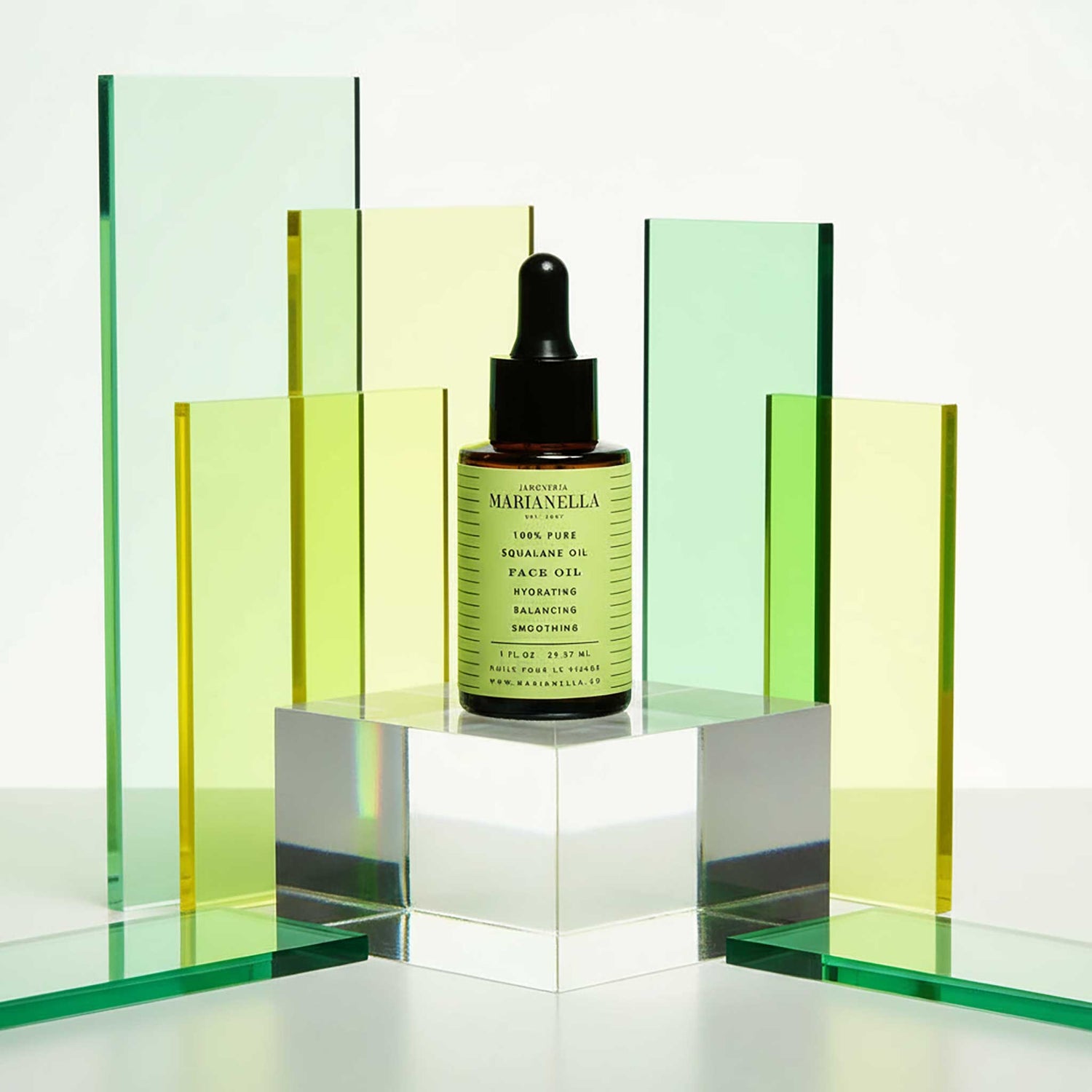
Squalane skincare benefits are backed by a growing body of clinical research, and in 2026, it remains one of the most well-validated emollients in modern dermatology. If you are looking for an ingredient that hydrates without heaviness, supports the skin barrier, and works across every skin type without exception, squalane belongs in your routine. Marianella's Squalane Face Oil distills 18 years of formulation expertise and three generations of Venezuelan botanical knowledge into a single, clean ingredient. $46.
What Is Squalane? A Clear Definition
Squalane is a saturated hydrocarbon derived from squalene, a lipid naturally produced by your own sebaceous glands. It is a colorless, odorless, transparent liquid with the chemical formula C₃₀H₆₂, a member of the triterpenoid hydrocarbon family and a fully hydrogenated saturated hydrocarbon.
The distinction between the two spellings matters. Squalene is highly unstable and oxidizes rapidly when exposed to air, making it unsuitable for skincare formulations. Squalane, created through hydrogenation, is completely stable and maintains all the beneficial properties without the oxidation concerns. That stability is precisely what makes squalane, not squalene, the form you find in high-performance skincare.
Its small molecular weight of 422.8 g/mol and excellent spreadability enable it to effectively fill intercorneocyte spaces, creating a more cohesive and impermeable barrier. That molecular profile is the reason squalane performs so differently from heavier oils.
Why Your Skin Needs Squalane for Skin After 30
Squalene makes up about 12% of the lipids that form human sebum. It is not a foreign substance. It is what your skin already produces to stay plump and protected. The problem is depletion over time.

During your twenties, squalene makes up approximately 10–12% of your skin's natural sebum, but production declines significantly as you age, dropping by as much as 60% by your fifties. This decline contributes to visible signs of aging, including dryness, fine lines, and loss of elasticity.
Research shows that this natural oil decreases with age, especially after age 30, which can contribute to dry, flaky skin that feels tight, itchy, or uncomfortable. Topical squalane replaces what biology gradually removes.
The Science Behind Squalane Skincare Benefits
Deep Hydration and Barrier Repair
Clinical research published in the Journal of Cosmetic Dermatology demonstrates that topical squalane application increases skin moisture by up to 40% while significantly reducing trans-epidermal water loss. This dual action means squalane does not just add moisture. It actively prevents moisture from escaping, creating lasting hydration that continues working throughout the day.
Research also demonstrates that just 0.05% squalane can reduce transepidermal water loss by 27%. That is a meaningful result at a very low concentration, which speaks to the ingredient's efficiency as a barrier-support molecule.
Studies demonstrate that squalane restores the lipid balance on the skin's surface, prevents trans-epidermal water loss, and protects against oxidative damage. It also acts as a carrier for other active substances, facilitating their penetration into the deeper layers of the skin, making it a versatile and essential ingredient in cosmetic formulations.
Antioxidant Protection
Research published in the Journal of Lipid Research demonstrated that squalane combats free radicals and reduces oxidative stress, which contributes to skin aging. Its primary function includes helping protect the skin from oxidative damage, particularly from UV light and other environmental stressors that generate free radicals.
Anti-Aging Properties
Research in the International Journal of Cosmetic Science revealed that squalane reduces the appearance of wrinkles and fine lines, improving skin elasticity. While not classified as a pharmacologically active anti-aging molecule, squalane contributes indirectly to skin renewal. By reinforcing the barrier and maintaining hydration, it fosters an optimal environment for keratinocyte differentiation and collagen synthesis.
Safe for Every Skin Type, Including Acne-Prone
One of the most important squalane skincare benefits for skeptics is its non-comedogenic profile. An American Academy of Dermatology study confirmed that squalane does not cause acne, making it safe for all skin types.
A 2024 clinical trial published in the International Journal of Cosmetic Science tested a 3% squalane serum on 50 participants with oily, acne-prone skin. Over 8 weeks of daily use, none of the participants reported an increase in breakouts or blackheads, and 72% saw a 21% reduction in excess sebum production.
Clinical findings confirm that squalane is non-comedogenic and hypoallergenic, even for acne-prone or sensitive skin, and it exhibits mild anti-inflammatory effects that reduce erythema and irritation. Research shows that squalane's anti-inflammatory properties may help reduce redness and swelling in acne and even other skin conditions like eczema.
Squalane's Molecular Advantage: Biomimicry
Among the most significant squalane skin benefits is its ability to provide biomimetic moisturization that works exactly like your skin's natural systems. Because squalane is molecularly identical to the squalene your body produces, it integrates seamlessly into your skin's lipid barrier without triggering sensitivity or congestion.
Squalane's low molecular weight and excellent skin affinity make it a star ingredient in skincare products. It can be quickly absorbed by the skin, penetrating deep into the stratum corneum, providing continuous moisturizing and hydrating effects without leaving greasy residue on the surface of the skin. This lightweight texture makes squalane suitable for all skin types, including oily, combination, and sensitive skin.
Modern, high-purity squalane represents a pinnacle of bio-mimicry, offering a combination of exceptional stability, lightweight skin feel, and innate biocompatibility that is difficult to match with synthetic alternatives.
Plant-Based Sourcing: The Standard in 2026
Sourcing matters, and the industry has moved decisively. Today, the majority of commercial squalane is obtained from plant-derived or bio-fermented sources such as olive pomace, rice bran, wheat germ, and sugarcane. Plant-based sources account for 75% of all squalane used in cosmetics globally, according to a 2024 report from Cosmetics Europe.
Plant-based squalane delivers identical molecular structure and squalane skin benefits while supporting environmental sustainability and cruelty-free beauty practices. High-grade cosmetic squalane is characterized by 92% or greater purity, verified through gas chromatography or HPLC. Purity is not a marketing claim. It is a measurable, verifiable specification.
How to Use Squalane for Skin: Routine Placement
Squalane is one of the most layerable oils in skincare. Its low molecular weight means it sits comfortably at multiple points in a routine without disrupting what comes before or after it.
As a Standalone Face Oil
Applied directly to clean, slightly damp skin, squalane locks in ambient moisture and creates a breathable surface film. The lightweight molecular structure of squalane allows it to penetrate deeply into the stratum corneum, delivering moisture to the deeper layers of skin while forming a breathable protective film on the surface. Use morning or evening, or both.
Layered Under Moisturizer
A few drops pressed into skin before your cream amplifies barrier performance. In formula development, squalane is often used as a matrix component in combination with other active ingredients to improve permeability and absorption efficiency. The same principle applies at home.
Mixed with Actives
Squalane is chemically inert and stable, which means it does not interfere with retinoids, acids, or peptides. For those who experience dryness or sensitivity from active ingredients, adding a drop of squalane to the routine provides a buffer without diluting efficacy.
Best Squalane Products 2026: What to Look For
The squalane category has expanded considerably. Choosing well requires a short checklist. Look for plant-derived sourcing, minimal additional ingredients, and high purity. This rare combination of lightweight texture and universal tolerance positions squalane among the safest and most effective emollients in dermatology. The formulation around the squalane matters as much as the squalane itself.
Marianella's Squalane Face Oil is the kind of product 18 years of small-batch formulation produces: precise, clean, purposeful. Handcrafted in Brooklyn and informed by three generations of Venezuelan botanical beauty tradition, it reflects the brand's approach to every one of its 82 products across face, body, and home. Featured in Vogue, Forbes, and Oprah. People Magazine Star Beauty Award winner. Now available at Bloomingdale's BEAUTYSPACE. $46.
The ingredient is well understood at this point. The science is not new, and the results are consistent. What varies is formulation integrity. A face oil built around pure, plant-derived squalane with nothing extraneous added is the simplest version of the argument for this ingredient, and often the most effective one.
Explore the Marianella Squalane Face Oil and see the full collection at Marianella.co.
```

Leave a comment
This site is protected by hCaptcha and the hCaptcha Privacy Policy and Terms of Service apply.