

Niacinamide Benefits: What the Research Actually Shows
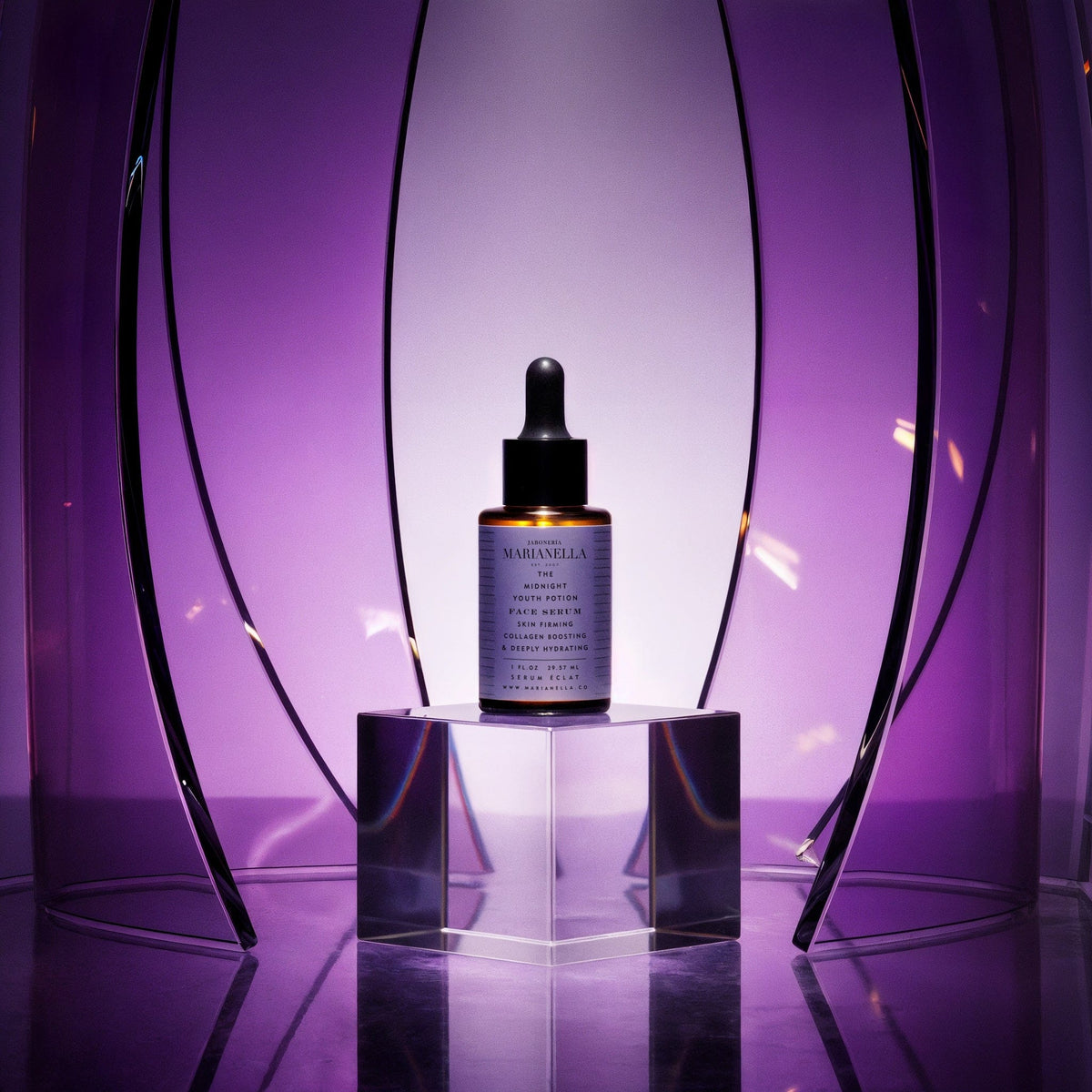
Niacinamide is a water-soluble form of vitamin B3 that supports the skin barrier, visibly refines the look of pores and texture, and helps even the appearance of skin tone when used consistently in a routine. Niacinamide, or vitamin B3, is a water-soluble essential vitamin and a precursor to the co-factors NAD and NADP, which play a key role in biochemical reactions including cellular energy production, glucose metabolism, and lipid synthesis. That mechanism is why the ingredient shows up in formulas across every price point in 2026, from drugstore serums to the eco-luxury shelf. At Marianella, it appears in The Midnight Youth Potion ($58), where it sits inside a small-batch, oil-infused formula handcrafted in Brooklyn.
What Is Niacinamide?
Niacinamide, also called nicotinamide, is the amide form of niacin, one of the eight B vitamins the body needs to function. Niacinamide is the heterocyclic aromatic amide form of water-soluble vitamin B3, known as niacin. The body makes niacinamide when there is excess niacin from foods like whole grains, meat, and milk, and it can also convert the amino acid tryptophan into niacinamide. In skincare, it is applied topically rather than eaten, and formulators favor it because it is gentle and versatile, and unlike retinoids and hydroxy acids, niacinamide is non-irritating. That gentleness is part of why the ingredient has held its place in serious formulations for years without falling out of favor.
The Molecular Story: NAD+ and Skin Aging
Niacinamide supplementation restores the cellular NAD+ pool and mitochondrial energetics, helps attenuate oxidative stress and inflammatory response, supports the extracellular matrix and skin barrier, and is studied for its role in the pigmentation process. The co-enzymes NAD and NADP decline as skin ages, and topical application of niacinamide helps address that decline in the co-enzymes that support cellular energy. This is the piece worth understanding before shopping for a serum: niacinamide is not surface polish, it is feeding a cellular process that slows naturally over time.
Niacinamide Benefits for Skin Barrier and Texture
The barrier is the skin's outermost defense, and niacinamide's most consistently studied benefit is here. Niacinamide is known to improve barrier function and reduce transepidermal water loss by increasing ceramide and free fatty acid levels. Independent formulation data echoes this at low doses: boosts to barrier function, including increased ceramides, have been observed at 4% concentration. A stronger barrier reads on the skin as less visible dryness, less reactivity to weather and product changes, and a smoother, more even surface to the touch.
Texture and Pore Appearance
Texture is where most people notice niacinamide first. Formulation research links improved skin texture and reduced appearance of pore size to a 4% concentration. A distinguishing feature of topical niacinamide is its effect on the visible appearance of sebum production and pore size. The result, over consistent use, is a surface that looks more refined under both daylight and the low golden light of early evening, when texture tends to show most.
Niacinamide and Sebum: What the Research Shows
Oil regulation is one of niacinamide's better-documented effects. Several clinical studies report that preparations with 2% to 5% niacinamide can meaningfully reduce the visible appearance of sebum following topical application, observed across both Asian and Caucasian study populations. The exact mechanism is still being mapped. The pathway behind niacinamide's sebum-reducing action in the skin remains under study. One theory ties back to the vitamin B3 family more broadly. Niacin, a related compound in the vitamin B3 family, has been shown to activate HCA2 receptors that regulate sebum production in human sebocytes, triggering a calcium response that lowers sebum output. Because niacin's carboxylic structure differs from niacinamide's amide group, niacinamide does not bind that same receptor directly, though it may be bio-converted to niacin and act on sebum indirectly through that pathway. The science is still resolving itself, which is honest to say out loud rather than oversell.
Niacinamide Benefits for Tone and Brightness
For anyone chasing a more even-looking complexion, tone is where niacinamide earns its reputation. Research has linked niacinamide to inhibiting the transfer of melanosomes, the pigment granules that move to the skin's outer layer, with one study showing a significant reduction in that transfer using a 5% niacinamide moisturizer. At the lower end, a 2% concentration has been associated in formulation studies with a more even-looking skin tone and reduced appearance of hyperpigmentation. This is the appearance-level story worth telling: not a claim about what happens inside the body, but a visible shift in how tone reads across the surface over time.
Antioxidant and Calming Properties
Underneath the brightening story is an antioxidant one. Niacinamide is essential for NAD+ synthesis and for PARP and sirtuin regulation, and by acting on these fundamental biochemical reactions within the cell, it displays notable antioxidant and anti-inflammatory activity. In practical terms on skin, in vitro studies show niacinamide reduces secretion of the cytokine interleukin-8 produced by keratinocytes, decreases lysosomal release and mast cell degranulation, and reduces UVB-induced PGE2 production by keratinocytes. Translated out of the lab: skin that looks calmer, with less visible redness and reactivity, especially after sun exposure or a long week.
Best Niacinamide Products 2026: Where It Fits in a Routine
The room reopens this season, and so does the routine. Niacinamide sits well early in a layering sequence, on clean skin, before heavier oils seal everything in. The Midnight Youth Potion ($58) carries niacinamide inside an oil-infused formula, handcrafted in small batches in Brooklyn, built for the evening ritual rather than a quick morning swipe. The choice for 2026 is less about chasing the highest percentage on a label and more about formulation quality, since niacinamide is a hydrophilic compound with poor natural partitioning into the skin's lipid matrix, which is why penetration and formulation matter as much as concentration.
Concentration: How Much Niacinamide Is Enough
Concentration in skincare typically ranges from 2% to 10%, with most formulations falling between 5% and 10%. Even concentrations as low as 2% have been shown to deliver meaningful benefit in studies. Higher is not automatically better. Testing shows niacinamide is relatively non-toxic and not a significant skin irritant, which is part of why it works across such a wide range of concentrations. For most routines, a well-formulated product in the 2% to 5% range, layered consistently, outperforms a high-percentage serum used sporadically.
The Marianella Standard
Marianella has been handcrafting since 2007, a story that began in Caracas and rebuilt itself in Brooklyn with small batches and clean ingredients, no shortcuts. That heritage shapes how ingredients like niacinamide get used inside a formula: not as a headline claim, but as one considered element inside a larger craft. The brand's eco-luxury catalog spans 82 SKUs across Face, Body, Hand, Home, and Fragrance, priced from $40 to $160, and has been recognized by Vogue, Forbes, Allure, and Oprah's Favorite Things, among others. Niacinamide's place in The Midnight Youth Potion follows that same logic: a botanical, oil-infused approach to an evening ritual, built around ingredients with a documented reason for being there.
Explore The Midnight Youth Potion ($58) to see how niacinamide is worked into a Marianella evening formula.
FAQ
What does niacinamide actually do for skin?
Niacinamide is marketed for anti-aging, redness, blemishes, and hyperpigmentation, and is known to improve barrier function and reduce transepidermal water loss by raising ceramide and free fatty acid levels. In short, it supports a stronger-looking, more even, better-hydrated surface over consistent use.

What percentage of niacinamide is best?
Most formulations fall between 5% and 10%, though studies show concentrations as low as 2% can deliver meaningful benefit. Sensitive skin often does better starting lower, then building up as tolerance allows.
Can niacinamide be layered with other actives?
Niacinamide is a flexible ingredient that can be combined with a wide range of other actives. It is generally considered one of the easier ingredients to layer into an existing routine without disruption.
Is niacinamide the same as niacin?
No. Niacin has a carboxylic structure, while niacinamide contains an amide group instead, and the two behave differently at the receptor level, though niacinamide may convert to niacin inside the body over time.
How long until niacinamide shows visible results?
Most formulation research points to consistent, low-and-steady change rather than an overnight shift. Visible improvements to tone, texture, and the look of pores tend to build gradually with regular, sustained use rather than a single application.


Dejar un comentario
Este sitio está protegido por hCaptcha y se aplican la Política de privacidad de hCaptcha y los Términos del servicio.