

Vitamin C skincare benefits are not a trend. They are among the most rigorously studied in modern dermatology, backed by decades of peer-reviewed research and increasingly refined by new findings in 2025 and 2026. If you are looking for a single ingredient that addresses collagen loss, oxidative damage, uneven tone, and skin thinning simultaneously, the science points to ascorbic acid. At Marianella, 18 years of formulation expertise inform how we put it to work.
What Is Vitamin C in Skincare?
Vitamin C is a powerful water-soluble antioxidant with a wide range of benefits for the skin. The chemically active form is L-ascorbic acid (LAA), which is used extensively in dermatological and cosmetic applications. In topical formulations, it functions on three primary levels: antioxidant defense, collagen synthesis co-factor, and melanin regulation. Each of these mechanisms operates independently, which is why vitamin C for skin works across multiple concerns at once.
Vitamin C is a normal skin constituent found at high levels in both the dermis and epidermis. The vitamin C content of the epidermis is higher than the dermis, though concentrations in both layers are approximately equal to other water-soluble antioxidants, including uric acid and glutathione. This natural presence is precisely why the skin responds well to topical delivery — it is replenishing something it already requires.
The Science Behind Vitamin C Skincare Benefits
Collagen Synthesis: The Molecular Connection
In addition to its antioxidant functions, vitamin C regulates the synthesis of the structural protein collagen. The role of vitamin C in the hydroxylation of collagen molecules is well characterized, and hydroxylation of collagen is necessary for its extracellular stability and support of the epidermis.

|
$50 |

|
$84 |

|
$50 |

|
$32 |
The process is specific. Vitamin C converts two amino acids, proline and lysine, into hydroxyproline and hydroxylysine through hydroxylation. This transformation allows collagen molecules to form their characteristic triple-helix structure, which gives collagen its strength and stability. Without it, structurally sound collagen cannot form.
Vitamin C benefits human skin physiology notably by stimulating the biosynthesis of collagen. The main cutaneous collagens are types I and III, which are less synthesized with aging. Starting in the mid-20s, collagen synthesis slows by approximately 1 to 1.5 percent per year. Topical vitamin C directly counteracts this decline at the gene-expression level.
As one of the most powerful antioxidants in the skin, vitamin C has been shown to protect against photoaging, ultraviolet-induced immunosuppression, and photocarcinogenesis. It also has an antiaging effect by increasing collagen synthesis, stabilizing collagen fibers, and decreasing collagen degradation. It decreases melanin formation, thereby reducing pigmentation.
New Research: Vitamin C Activates Skin's Youth Genes
The most compelling research to emerge in 2025 comes from the Journal of Investigative Dermatology. Researchers in Japan discovered that vitamin C helps thicken the skin by directly activating genes that control skin cell growth and development. Their findings suggest that vitamin C may restore skin function by reactivating genes essential for epidermal renewal.
The mechanism is epigenetic. The researchers concluded that vitamin C helps thicken the skin by encouraging keratinocyte proliferation through DNA demethylation, making it a promising treatment for thinning skin, especially in older adults. This is not a surface-level cosmetic effect. It is biological renewal at the cellular level.
Separately, a 2025 University of Otago study published in the Journal of Investigative Dermatology confirmed that one of the most significant findings was a measurable rise in skin thickness among participants, indicating increased collagen production along with faster regeneration of epidermal cells.
Antioxidant Defense and UV Damage
In the process of aging and in sensitive skin, the role of reactive oxygen species (ROS) must be taken into account. The skin, as the external part of the body, is constantly exposed to ultraviolet radiation, which leads to the production of ROS. Vitamin C neutralizes these free radicals before they degrade collagen and elastin.
Vitamin C is the primary replenisher of vitamin E and works synergistically with vitamin E in the protection against oxidative damage. This is one reason why well-formulated serums pair vitamin C with complementary antioxidants, multiplying the protective effect rather than relying on a single molecule.
Skin Tone and Hyperpigmentation
Vitamin C not only stimulates collagen synthesis but also acts as a cofactor for collagen-stabilizing lysine and proline hydroxylases and inhibits metalloproteinase-1 (MMP-1) activity. MMP-1 is the enzyme most responsible for collagen breakdown, which means vitamin C works on both ends: building collagen and preventing its destruction. Its ability to inhibit melanin formation additionally addresses dark spots and post-inflammatory discoloration, making it one of the few ingredients with meaningful evidence for uneven skin tone.
Studies found that skin treated with vitamin C was smoother and less wrinkled than skin treated with a placebo. This is the clinical floor. Formulation quality, concentration, and delivery system determine how far above that floor a product actually performs.
The Formulation Challenge: Why Delivery Matters
Vitamin C's efficacy is only as strong as its ability to reach the dermis. Vitamin C dissolves easily in water and does not absorb well through the outer skin barrier. This is the central challenge every serious formulator faces. L-ascorbic acid is the most bioavailable form but also the most chemically unstable, oxidizing rapidly when exposed to light, air, and heat.
Clinical studies on the efficacy of different formulations of topical vitamin C in human skin remain limited. The challenge lies in developing a stable formulation and finding the most efficient transepidermal delivery method for the esterified forms of vitamin C to maximize the concentration of active vitamin C in the skin.
This is not a problem that commodity formulas solve. It requires real formulation discipline. Marianella's approach draws on 18 years of small-batch craftsmanship in Brooklyn and three generations of Venezuelan botanical beauty knowledge, applying that depth of expertise to create serums where vitamin C remains active at the moment of contact with skin.
Vitamin C and Niacinamide: The Combination Worth Understanding
One of the most researched pairings in modern skincare is vitamin C with niacinamide. Ascorbic acid is an essential nutrient with great potential as a cosmeceutical that protects the health and beauty of the skin. It is expected to attenuate photoaging and the natural aging of the skin by reducing oxidative stress caused by external and internal factors and by promoting collagen gene expression and maturation. Niacinamide supports the skin barrier, reduces transepidermal water loss, and works on hyperpigmentation through a separate pathway, making the two ingredients complementary rather than redundant.
The combination is particularly relevant for skin that is simultaneously dealing with collagen loss, tone irregularity, and compromised barrier function — which describes most adult skin after the age of 30.
Best Vitamin C Products 2026: Marianella's Lineup
Marianella, winner of the People Magazine Star Beauty Award and featured in Vogue, Forbes, and Oprah, now available at Bloomingdale's BEAUTYSPACE, formulates vitamin C across multiple serum formats to address different skin concerns and skin depths. Each one is handcrafted in Brooklyn in small batches, where quality control is direct rather than institutional.
Vitamin C Collagen Boosting Face Serum with Niacinamide
The most direct expression of vitamin C's documented benefits in the Marianella lineup. This serum is built around the collagen synthesis and antioxidant mechanisms the research supports, combined with niacinamide for barrier reinforcement. The pairing targets fine lines, uneven tone, and surface texture in a single formula.
Vitamin C Collagen Boosting Face Serum with Niacinamide. $50.
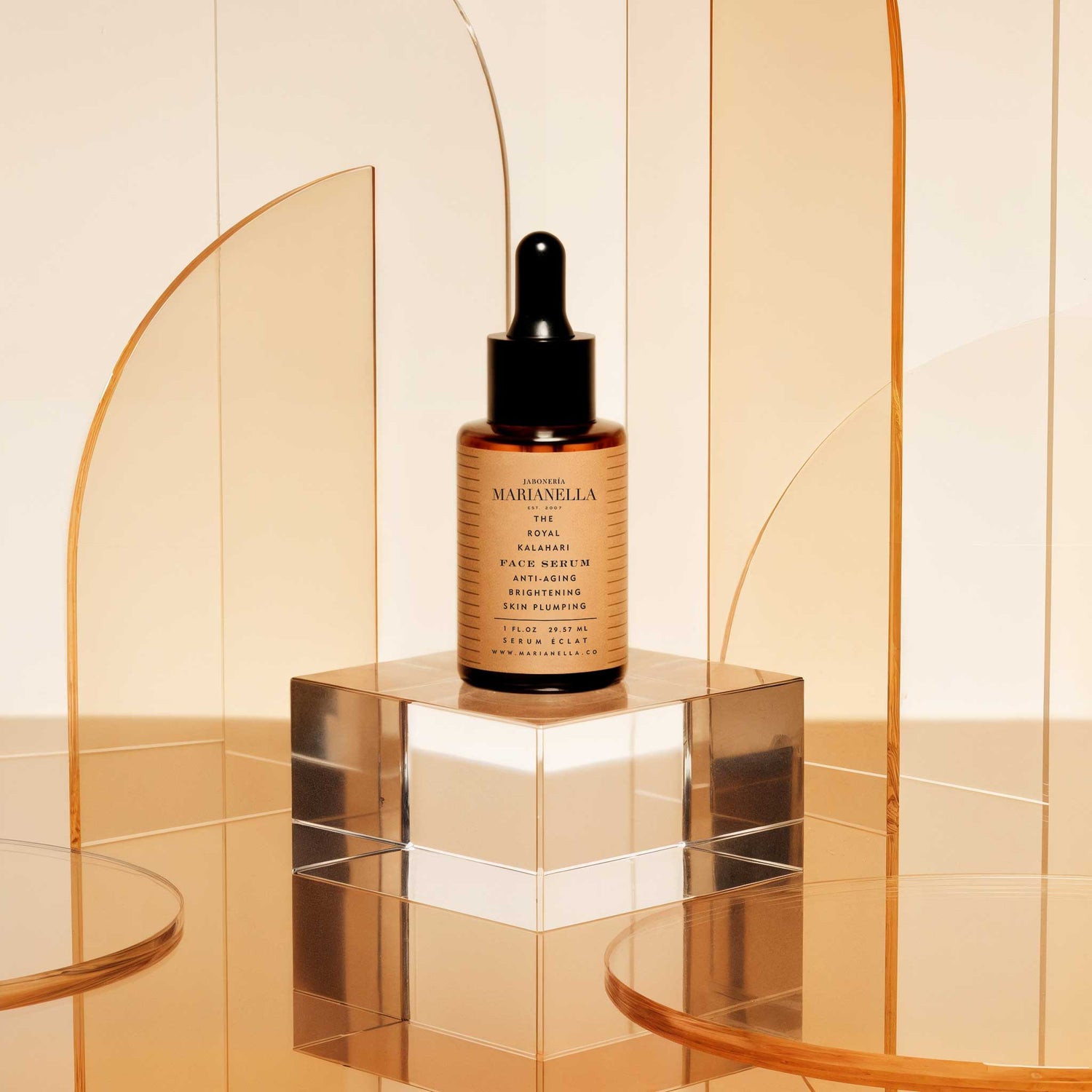
The Royal Kalahari Face Serum
Named for one of the most botanically rich desert regions on earth, this serum draws on Marianella's deep botanical heritage. The Royal Kalahari Face Serum is formulated for intensive daily use, bringing together the antioxidant depth that vitamin C anchors with rare plant actives sourced through the brand's three-generation botanical knowledge base.
The Royal Kalahari Face Serum. $50.
Wrinkle Reducing Ultra Peptide Intensive Face Serum
For skin where collagen loss is the primary concern, this serum pairs vitamin C's collagen co-factor activity with peptides, which signal fibroblasts directly to increase collagen production. The two mechanisms are additive: vitamin C supports the biochemical machinery of collagen assembly while peptides stimulate the cellular instructions upstream. The result is a formula built for meaningful anti-aging work, not surface maintenance.
Wrinkle Reducing Ultra Peptide Intensive Face Serum. $84.
The Royal Kalahari Under Eye and Lip Serum Roller Oil
The delicate tissue around the eyes and lips is where vitamin C's collagen and antioxidant activity matters most. This zone is thinner, more mobile, and more exposed to UV-generated free radicals than the rest of the face. A dedicated roller-oil delivery format allows precise application with a cooling, low-friction mechanism that protects the skin it is treating.
The Royal Kalahari Under Eye and Lip Serum Roller Oil. $32.
How to Use Vitamin C for Skin: Protocol and Layering
Morning vs. Evening
Vitamin C is most effective in the morning. Its antioxidant function is forward-facing — it neutralizes free radicals generated throughout the day by UV exposure and environmental pollution. Applying it before sunscreen creates a biochemical defense layer that SPF alone cannot provide, since vitamin C is not a sunscreen because it does not absorb light in the UVA or UVB spectrum. The two work through entirely different mechanisms and are not interchangeable.
Concentration and Stability
L-ascorbic acid, the most bioactive form, penetrates skin most effectively but can be unstable. Signs of oxidation in a vitamin C product include a color shift toward yellow or amber and a decrease in efficacy. Store vitamin C serums away from direct light, close caps tightly, and use within the period indicated after opening. Stability is a formulation problem that good manufacturing practice resolves at the source.
What It Pairs Well With
Vitamin C is the primary replenisher of vitamin E and works synergistically with vitamin E in the protection against oxidative damage. Niacinamide, hyaluronic acid, and peptides are all compatible partners. Approach direct acids with care in the same routine — a slightly acidic pH helps vitamin C absorption, but very low pH formulas used immediately before or after can cause sensitivity in some skin types.
Vitamin C for Skin in 2026: What the Research Confirms
The most current science, published across 2025 and into 2026, confirms and expands what earlier studies established. Researchers in Japan discovered that vitamin C helps thicken the skin by directly activating genes that control skin cell growth and development. Their findings, published in the Journal of Investigative Dermatology in April 2025, suggest that vitamin C may restore skin function by reactivating genes essential for epidermal renewal. This places vitamin C beyond the category of "antioxidant brightener" and into the domain of genuine skin-architecture support.
Vitamin C is an essential part of skin health both as a small molecular weight antioxidant and as a critical factor for collagen synthesis. Vitamin C contributes to photoprotection, decreases photodamage, and is needed for adequate wound healing. For a single topical ingredient, that is a formidable profile.
Marianella has been handcrafting in Brooklyn since 2007, building 82 products across face, body, and home with the kind of attention to ingredient quality that small-batch production makes possible. Vitamin C sits at the center of several of those formulas because the science earns it a place there.
Browse the full Marianella vitamin C serum collection and find the formula built for your specific concern.
```


Leave a comment
This site is protected by hCaptcha and the hCaptcha Privacy Policy and Terms of Service apply.