

Tamanu oil skincare benefits are not a trend. They are the outcome of centuries of documented botanical practice, now substantiated by peer-reviewed cell culture studies, chromatographic analysis, and clinical observations. If you are looking at the best tamanu oil products in 2026, the science behind the ingredient matters as much as the formulation around it. Here is what the research actually says, and why this oil holds a specific place in Marianella's 18 years of small-batch work.
What Is Tamanu Oil?
Tamanu oil comes from Calophyllum inophyllum L., an evergreen pantropical tree known locally as "tamanu" in French Polynesia, growing mostly along the seashores. It is a fatty nut oil pressed from the fruit seeds of the tree, and the nuts must be cracked, the seeds removed, and then dried in the sun for one to two months before cold-pressing releases the oil. The result is a distinctively dark green, viscous oil with a characteristic earthy, nutty scent.
Tamanu oil is characterized by the presence of a resinous part that is unparalleled in any other plant-origin oil. It accounts for about 10 to 20 percent of the oil and is soluble in ethanol, with a composition consisting mainly of neoflavonoids and pyranocoumarin derivatives. This is what separates tamanu oil from generic plant oils. It is not simply a fatty acid carrier. It carries bioactive compounds that have no direct equivalent in other botanical oils.
The Chemistry Behind Tamanu Oil for Skin
Fatty Acid Composition
Chromatography and mass spectrometry analysis identified the prime fatty acids in tamanu oil as palmitic acid (12.69%), stearic acid (13.52%), oleic acid (41.88%), and linoleic acid (29.94%). These are not arbitrary numbers. Oleic acid at nearly 42 percent means strong emollient and skin-barrier-supporting capacity. Linoleic acid at nearly 30 percent directly supports the lipid matrix of the stratum corneum, the outermost layer responsible for moisture retention and environmental defense.


Calophyllolide: The Rare Compound That Defines Tamanu Oil
Calophyllolide is a rare compound found almost exclusively in tamanu oil, and it boasts impressive anti-inflammatory and skin-regenerating properties. Rich in calophyllolide, a natural nonsteroidal anti-inflammatory agent, and delta-tocotrienol, a powerful antioxidant, tamanu oil delivers unique regenerative effects. No other commercially prevalent plant oil combines these two compounds in this way. It is the molecular distinction that makes tamanu oil perform differently from rosehip, argan, or marula in a serum formulation.
Compounds like calophyllolide and coumarins in tamanu oil demonstrate anti-inflammatory activity by inhibiting inflammatory pathways and providing a natural remedy for skin redness and irritation. Studies have shown that tamanu oil inhibits the production of inflammatory cytokines and reduces inflammatory responses in skin tissue. For anyone dealing with reactive, post-procedure, or chronically sensitized skin, this mechanism is clinically meaningful.
Tamanu Oil Skincare Benefits: What the Research Shows
Collagen and Glycosaminoglycan Production
This is where the science gets specific. Research on human skin cell cultures (keratinocytes HaCaT and dermal fibroblasts HDF) showed cell proliferation for up to 18 hours of incubation, with an increase relative to control cells of 10 to 40 percent for HaCaT and 5 to 20 percent for HDF at all dilutions. Glycosaminoglycan (GAG) and collagen production, as well as wound healing activities, were evaluated, and an increase of collagen production of 10 to 40 percent was observed depending on the duration of incubation.
To understand why that matters: glycosaminoglycan (GAG) helps make collagen in the skin, and the production of GAG and collagen is what positions tamanu oil as a wound-healing agent. GAG production also declines with age, contributing to thinning skin and loss of structural integrity. An ingredient that measurably stimulates both pathways simultaneously is not common.
Research showed that tamanu oil emulsion accelerates wound closure in both keratinocyte and fibroblast cells, surpassing the effects of vitamin C used as a positive control. It not only stimulates cell proliferation but also increases glycosaminoglycan and collagen production, demonstrating comprehensive wound-healing capabilities.
Anti-Inflammatory Action
A number of in vitro and in vivo studies investigating various skin-active properties of tamanu oil have proven it to have potent anti-inflammatory, antioxidant, antimicrobial, analgesic, and wound-healing abilities. For formulation purposes, anti-inflammatory action in a serum or night treatment is not just about soothing. It is about reducing the chronic low-grade inflammation that accelerates visible aging, compromises barrier function, and increases sensitivity to environmental stressors.
Antibacterial and Antimicrobial Properties
A 2015 study found that tamanu oil exhibited high antibacterial and wound-healing activity against bacterial strains involved in acne, including Propionibacterium acnes and Propionibacterium granulosum. Tamanu oil contains several compounds with proven antibacterial, antifungal, and antiviral activities. The coumarins and xanthones in the oil are particularly effective against a wide range of pathogens.
UV Defense and Antioxidant Activity
A 2009 in-vitro study found that tamanu oil was able to absorb UV light and inhibit 85 percent of the DNA damage induced by UV radiation. This does not replace broad-spectrum SPF, and it should not be used as one. But as a secondary antioxidant layer in a serum, the UV-absorbing capacity of tamanu oil compounds adds a meaningful degree of photoprotection when layered beneath sunscreen. Coumarins and other potent antioxidants in tamanu oil help protect the skin from damaging free radicals, which can contribute to premature aging.
Skin Regeneration and Scar Support
Biological activity studies confirmed skin-active effects of tamanu oil treatment including antimicrobial protection, anti-inflammatory activity, wound healing, and the promotion of extracellular matrix production, specifically GAG and collagen. The oil has wound-healing and skin-regenerating capabilities and encourages the growth of new skin cells, all of which are helpful for fading scars and hyperpigmentation, as well as promoting an overall glow.
How Marianella Uses Tamanu Oil
Marianella has been handcrafting botanical formulas in Brooklyn since 2007. Eighteen years of small-batch production means every ingredient in every formula has been selected against a standard of both efficacy and compatibility. Three generations of Venezuelan botanical knowledge shape which ingredients earn their place in a formula, and tamanu oil is one that earns it on chemistry alone. It is featured in Vogue, Forbes, and Oprah, and available now at Bloomingdale's BEAUTYSPACE, because the work behind it holds up to scrutiny.
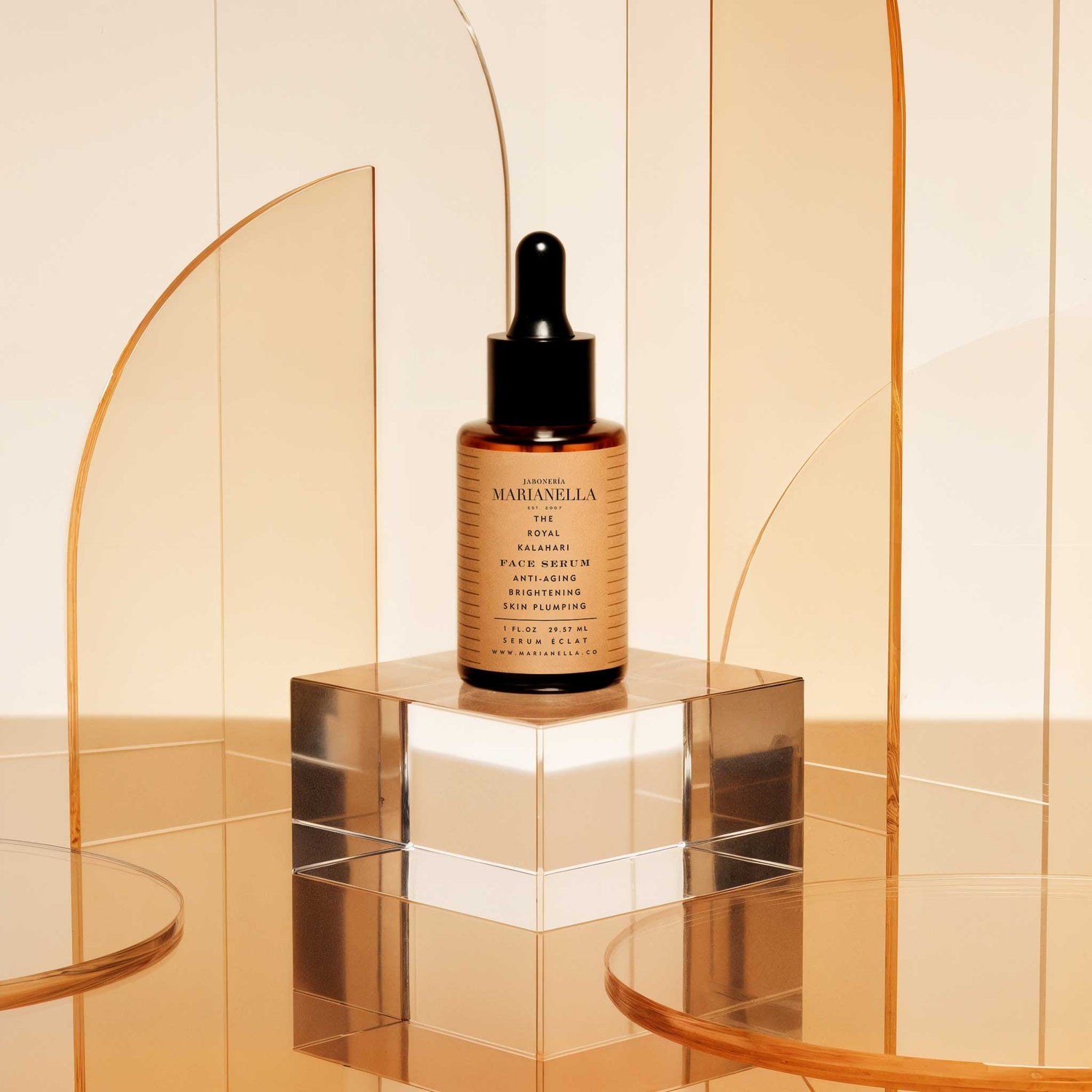
The Royal Kalahari Face Serum
Tamanu oil appears in The Royal Kalahari Face Serum, a daily-use face serum built for skin that needs measurable results, not promises. The formulation reflects Marianella's approach: botanically intelligent, precisely structured, and without filler. $72.
The Midnight Youth Potion
The Midnight Youth Potion is Marianella's overnight treatment, where tamanu oil works within a nocturnal repair context. Overnight is when the skin's cellular renewal rate peaks, and tamanu oil's collagen-stimulating and GAG-boosting properties are well-matched to that biological window. This is the product that won Marianella the People Magazine Star Beauty Award. $72.
Who Should Use Tamanu Oil for Skin
Tamanu oil is included in different cosmetic formulations as an active ingredient for skin regeneration, after-sun protection, soothing and irritation calming, and wrinkle and stretch mark prevention. That is a wide clinical range, and it maps accurately to who finds this ingredient useful.
Skin types and conditions that respond well to tamanu oil in 2026 formulations:
- Post-acne and congested skin. The antibacterial activity against P. acnes and anti-inflammatory properties work together to address both active blemishes and residual marking.
- Mature skin. Recent studies have shown that tamanu oil emulsion has the ability to stimulate the production of collagen and hyaluronic acid in fibroblasts, with a 10 to 40 percent increase in collagen production in treated skin cells.
- Sensitized or reactive skin. Tamanu oil's standout feature is its extraordinary anti-inflammatory prowess, which is crucial for sensitive or reactive skin.
- Skin recovering from sun exposure or environmental stress. The UV-absorbing compounds and antioxidant fraction provide meaningful secondary-layer protection.
One note: some people, including those with tree nut allergies, should not use tamanu oil. Patch testing is always recommended before incorporating any new botanical oil, regardless of skin type.
What Makes Tamanu Oil Different from Other Plant Oils
Most plant oils offer fatty acid delivery. Some add antioxidant value. Tamanu oil does both, and then adds the resinous neoflavonoid-and-pyranocoumarin fraction that no other standard botanical oil contains. Unlike traditional vegetable oils, tamanu oil contains not only essential fatty acids such as oleic and linoleic acid, but also a resinous fraction rich in neoflavonoids and pyranocoumarins. These bioactive compounds, in particular calophyllolide, have been shown to have beneficial effects on the skin, including stimulating collagen and regulating inflammatory processes.
Unlike many oils that sit on the skin's surface, tamanu oil penetrates deeply to renew from within without clogging pores. For formulation stability and consumer experience, this matters. An oil that sits on top of the skin creates occlusion without cellular activity. Tamanu oil does not behave that way.
The Broader Context: Traditional Use Meets Modern Verification
Bioassays and different assessments of tamanu oil have revealed numerous biological activities including antioxidant, anti-inflammatory, antibacterial, and wound-healing effects, bringing scientific evidence to the beneficial effects of this oil on human skin. Oil extracted from the seeds is traditionally used topically to treat a wide range of skin injuries from burns, scars, and infected wounds to skin diseases such as dermatosis, urticaria, and eczema.
The story of tamanu oil is one of traditional knowledge surviving long enough for modern instrumentation to confirm it. That is the kind of ingredient Marianella was built to work with. Not novelty, not trend cycling. Botanical science with provable depth, formulated by hand, in Brooklyn, for the past 18 years.
Where to Find Marianella Tamanu Oil Products in 2026
Both The Royal Kalahari Face Serum and The Midnight Youth Potion are available directly at marianella.co and at Bloomingdale's BEAUTYSPACE. The full Marianella range spans 82 products across face, body, and home, with prices from $12 to $160.
If you are rebuilding a routine around scientifically grounded botanicals, tamanu oil is a strong anchor. Start with the formulas that earned the press and the awards, and let the ingredient do what the research says it does.
```

Leave a comment
This site is protected by hCaptcha and the hCaptcha Privacy Policy and Terms of Service apply.