

Peptides are short chains of amino acids that act as signals in the skin, telling fibroblasts to build more collagen. That is the whole of the peptides benefits story in one line, and everything below is the evidence behind it. Unlike an exfoliating acid, which works by removing, a peptide works by instructing. It does not resurface skin. It asks the cells already living in the dermis to do more of what they did easily at twenty-five and do slowly now.
Most people meet peptides at an odd hour. Eleven at night, one lamp on, face damp, leaning close enough to the mirror to see the line that only shows when the light comes from the side. Not a crisis. Just a small new fact about a face you have known your whole life. The question that follows is always the same: is there anything in a bottle that actually does something, or is this all marketing. For peptides, there is a real answer, and it has numbers attached.
What is a peptide in skincare?
A peptide is a molecule made of a small number of amino acids linked together, shorter than a protein but built from the same units. Each amino acid typically weighs between 80 and 110 Daltons, so a peptide of five or six amino acids is very small by molecular standards. In skincare, the most studied family are the signal peptides, also called matrikines. Matrikines are bioactive peptide fragments released from the extracellular matrix during normal remodeling; when collagen is cleaved by matrix metalloproteinases, KTTKS-containing fragments are released, and those fragments tell fibroblasts to increase collagen synthesis as a repair response. A topical peptide borrows that vocabulary. It is designed to look like a collagen breakdown fragment, so fibroblasts upregulate collagen synthesis without any collagen actually having been degraded.
The best known is palmitoyl pentapeptide-4. It consists of the KTTKS sequence, lysine-threonine-threonine-lysine-serine, with a palmitoyl fatty acid attached to the N-terminus. The KTTKS structure is related to the precursor of collagen Type I. In other words, the peptide is a five-letter word the skin already knows how to read.
How peptides work: the 500 Dalton problem
Here is the tension at the center of peptide chemistry, and the reason cheap peptide products often do nothing. The conventional rule in transdermal pharmacology, from a 2000 review by Bos and Meinardi in Experimental Dermatology, holds that molecules below 500 Daltons can cross the skin barrier. Most cosmetically active peptides fall between 500 and 1,500 Da, putting them at or above that threshold, and their water-loving character adds a second obstacle, because the lipid matrix of the stratum corneum resists water-soluble molecules. KTTKS itself has a molecular weight of 563.64 Da. Slightly too heavy, and entirely the wrong personality, to get through a barrier evolved to keep the world out.

|
$72 |

|
$96 |
Why the fatty acid tail matters
The fix is elegant and nearly fifty years of cosmetic chemistry rests on it. A fatty acid tail, typically palmitic acid, a 16-carbon chain, is attached to the peptide's amino terminus. The palmitoyl group increases the peptide's lipophilicity, improving passage through the stratum corneum into the dermis where fibroblasts live. The palmitoylation is not incidental; it is the structural modification that enables dermal penetration. Adding it makes the molecule heavier, 802.05 Da for pal-KTTKS, yet more able to travel, which is the counterintuitive part. Lintner and Peschard described this in the International Journal of Cosmetic Science in 2000, showing that long-chain fatty acid conjugates solved both penetration and stability, and that work underpins most commercial signal peptides today.
So when you read palmitoyl on an ingredient list, you are reading a delivery decision, not a filler. It is the difference between a message written and a message sent.
Peptides benefits: what the clinical research actually shows
The honest summary is that peptides have one of the better evidence bases in cosmetic ingredients, and that the strongest claims are about the appearance of lines rather than about reversing time. Signal peptides of the matrikine-mimetic class are, as of April 2026, still cosmetic ingredients rather than approved drugs, and the clinical evidence supports measurable improvement in the appearance of wrinkles when the concentration is adequate.
Wrinkle depth and fine lines
The most cited human trial is a split-face design. Ninety-three participants aged 35 to 55 used a moisturizer on one side and the identical moisturizer containing 3 ppm pal-KTTKS on the other for 12 weeks, double-blind and randomized; the peptide side showed significant improvement against the placebo control for reduction in wrinkles and fine lines, measured both by image analysis and by expert graders, and it was well tolerated. Separately, a 12-week double-blind study found 2% Matrixyl reduced wrinkle area by 36% versus placebo, though that study was manufacturer-sponsored, which is a limitation worth naming.
Firmness, elasticity and the matrix underneath
Peptide benefits are not only about lines on the surface. Palmitoyl pentapeptide-4 has been reported to stimulate production of elastin, fibronectin, glycosaminoglycan and collagens, specifically Types I, III and IV, supporting the extracellular matrix and wound healing. Its effect on collagen I, III and fibronectin appears to work mainly through the biosynthetic pathway rather than by slowing export or degradation, meaning the skin is making more, not simply losing less. Other peptides target different structures. Palmitoyl hexapeptide-12, derived from elastin, acts as a chemoattractant for fibroblasts in vitro and improved skin elasticity and tone applied topically. In a study of 15 participants, a cream with palmitoyl tripeptide-1 applied twice daily for four weeks produced statistically significant reductions in wrinkle length, depth and roughness.
The repair angle most people miss
Published research has reported peptide benefits for reducing fine lines and wrinkles, tightening skin, reducing the appearance of open pores, calming inflammation, protecting against sun damage and speeding wound healing. Bioactive peptides are increasingly favored because of their versatility, high target specificity, and minimized toxicity and immunogenicity. That last point is why peptides suit people whose skin cannot tolerate a nightly retinoid. A peptide does not provoke. It suggests.
Best peptides products 2026: what to look for, and what we make
Choosing among the best peptides products in 2026 comes down to three questions. Is the peptide lipid-conjugated, so it can travel. Is it in a base you will actually use every night, because 12 weeks is the timeline every trial above used. And is the formula made in batches small enough that the actives are fresh when they reach you.
Marianella has been answering the third question since 2007. We are the only Venezuelan-founded, independent, luxury skincare and home fragrance brand in the United States, and everything across our 82 SKUs is made in small batches by hand in Brooklyn. The story starts in Caracas, in the simple joy of making something beautiful out of what grows, and it was rebuilt from nothing when the family came to the United States. Small batches, clean ingredients, no shortcuts. That method has been recognized by Vogue, Forbes, Allure, the New York Times, Harper's Bazaar and Oprah's Favorite Things, and our products sit in Bloomingdale's BEAUTYSPACE.
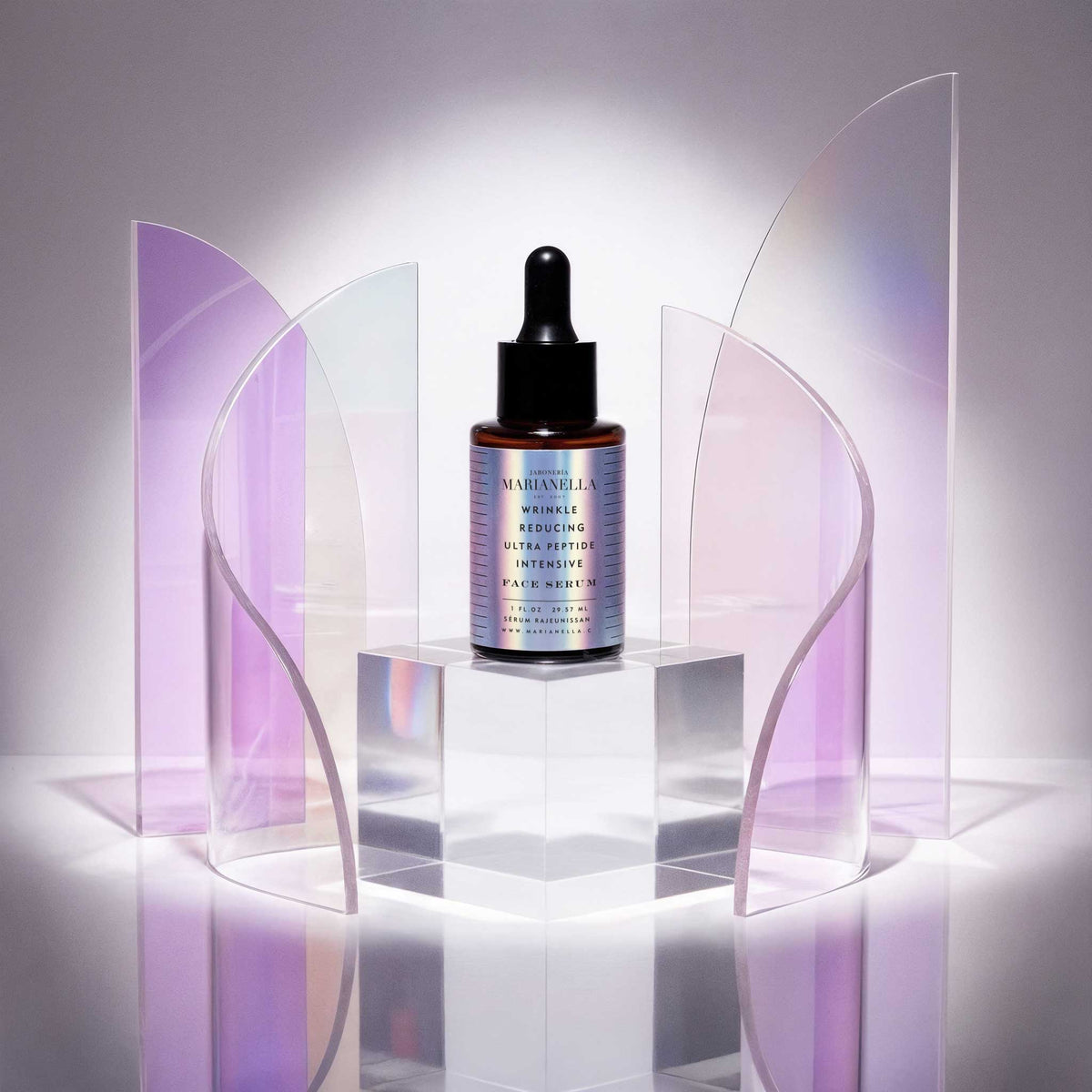
Wrinkle Reducing Ultra Peptide Intensive Face Serum, $72
The serum is the daily instruction. It goes on after cleansing, onto skin still slightly damp, before anything heavier, and it is the layer that carries peptides closest to where fibroblasts work. Two to three drops, pressed rather than rubbed, across the forehead, the outer eye, the two lines that bracket the mouth. Find it at Wrinkle Reducing Ultra Peptide Intensive Face Serum.
Wrinkle Reducing Ultra Peptide Intensive Night Cream, $96
The night cream is the long game. Sleep is when the skin does its structural work, and a peptide cream is a way of leaving a note on the counter before the shift starts. Layer it over the serum, or use it alone if your skin runs dry. Find it at Wrinkle Reducing Ultra Peptide Intensive Night Cream. Together the two run $168, which places them in the same range as the rest of our line, $40 to $160.
How to use peptides so they actually work
Consistency beats concentration. The pal-KTTKS trial that produced significant results used only 3 ppm, applied for 12 weeks. Three parts per million, twice a day, for three months. Nobody in that study got results in a week, and nobody should expect to.
Apply to damp skin. Thin layers first, richer ones after. Peptides pair comfortably with hyaluronic acid, niacinamide and ceramides, and they suit sensitive skin better than most actives because they work by signaling rather than by exfoliating. If you use a strong acid, put it on a different night, not because peptides are fragile in general but because a disrupted barrier is a poor place to start a conversation about collagen. And use sunscreen every morning, since there is no point asking fibroblasts to build collagen while UV tears it down.
If you want one place to begin, start with the serum at night for 12 weeks and photograph your face in the same light on week one and week twelve.
FAQ
What do peptides do for your face?
Peptides signal skin cells to produce more structural proteins. Short chains of amino acids can mimic natural extracellular matrix components and modulate gene expression tied to skin structure, and palmitoyl pentapeptide-4, derived from collagen type I sequences, stimulates fibroblast activity and promotes production of collagen types I and III as well as fibronectin. Visible results appear as softer fine lines and better firmness over roughly 12 weeks.
Do peptides really penetrate the skin?
Only with help. Normal skin is impermeable to most molecules larger than 500 Daltons, and bioactive peptides, being both large and water-loving, do not easily penetrate on their own. Palmitoylated peptides have shown greater skin permeation than unmodified conventional peptides, which is why the palmitoyl prefix on an ingredient list matters more than the peptide count.
How long do peptides take to work?
Plan on 12 weeks for wrinkle changes, though some measures move sooner. One study using palmitoyl tripeptide-1 twice daily recorded statistically significant reductions in wrinkle length, depth and roughness at four weeks, while the larger split-face pal-KTTKS trial ran 12 weeks before assessment. Hydration and smoothness usually improve first, structural change second.
Can peptides be used with retinol or vitamin C?
Yes, with sensible spacing. Peptides are among the gentlest categories in skincare, since they are valued for high target specificity and minimized toxicity and immunogenicity. Many people use vitamin C in the morning and peptides at night. If your barrier is irritated, use peptides alone for two weeks first, then reintroduce the stronger active.
Are peptides better than collagen creams?
For topical use, generally yes. Collagen itself has a large molecular weight and struggles to cross the skin barrier to reach the layer where it would act. A peptide takes the opposite approach: instead of delivering the finished material, it delivers the instruction to make it, which is a much smaller package to send.

Leave a comment
This site is protected by hCaptcha and the hCaptcha Privacy Policy and Terms of Service apply.