

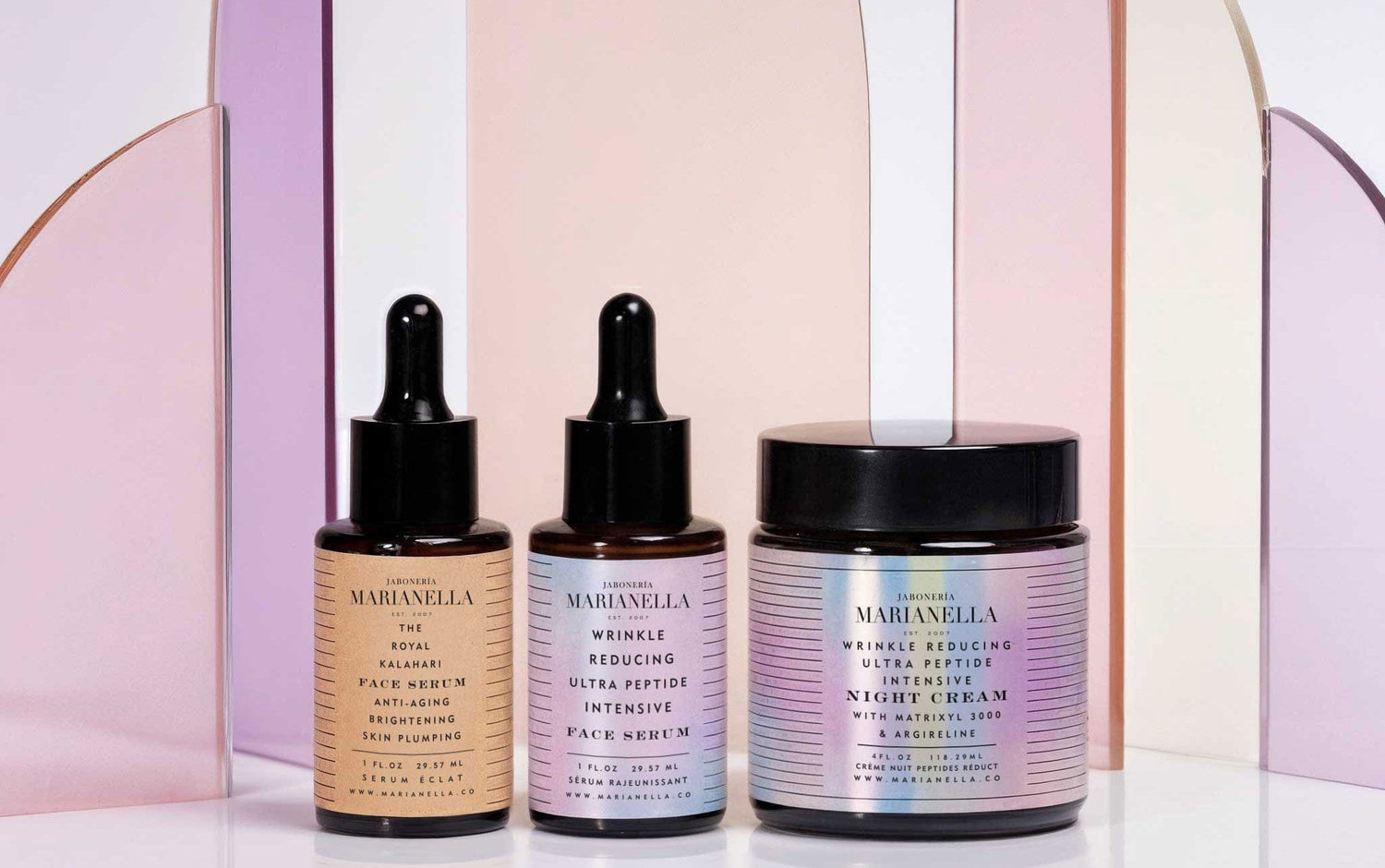
Peptides skincare benefits are no longer a niche concern for cosmetic chemists. In 2026, peptides sit at the center of serious anti-aging science, and the research is compelling enough that dermatologists, biochemists, and independent formulators are all paying close attention. If you want to understand what peptides actually do for skin and which peptide products are worth your attention, this is a complete breakdown.
What Are Peptides? A Clear Definition
Peptides are short chains of amino acids, the building blocks of proteins like collagen and elastin. In skin biology, they function as signaling molecules, communicating instructions to cells that determine how the skin repairs and maintains itself. A peptide can contain anywhere from two to dozens of amino acids linked in sequence, and that sequence determines exactly what the peptide tells the skin to do.
Peptides are active ingredients that improve collagen synthesis, enhance skin cell proliferation, or decrease inflammation. That three-part function is why they have become foundational to modern anti-aging formulation. No other single ingredient class addresses all three simultaneously.
The Collagen Problem: Why Peptides Matter at Every Age
The biological case for peptides begins with one number. After about age 25, the body produces roughly one percent less collagen per year. Though that number seems small, the effect compounds. Collagen constitutes 70 to 80 percent of the dry weight of human skin. It is the rope-like protein network in the dermis that gives faces volume, strength, and elasticity.

|
$84 |

|
$112 |
With age, fibroblasts produce less collagen and degrade more due to matrix metalloproteinases (MMPs). Chronologically aged skin shows a 68% reduction in type I procollagen in people over 80 relative to those aged 18 to 29. Women can lose up to 30 percent of their skin collagen in the five years after menopause, while dermal thickness decreases about 6 percent per decade for both sexes.
Peptides for skin are one of the most direct topical strategies for addressing this trajectory. They do not simply mask the signs of collagen loss. Several classes work at the cellular level to slow or partially reverse it.
The Four Classes of Skin Peptides and What They Do
Not all peptides work the same way. Signal peptides stimulate fibroblast cells to increase collagen production and improve skin elasticity; neurotransmitter inhibitor peptides relax facial muscles, minimizing expression wrinkles; carrier peptides deliver essential trace elements to support skin repair; and enzyme inhibitor peptides reduce collagen breakdown, preserving the integrity of the skin. Understanding these classes is how you evaluate a formula rather than just a label claim.
Signal Peptides: Collagen Communication
Signal peptides are designed to communicate with different parts of the skin, promoting collagen, elastin, and other protein production. They help in repairing damage and fighting signs of aging. Think of them as a message sent directly to fibroblasts, the cells responsible for manufacturing the skin's structural proteins. When specific peptides penetrate the skin, they act as cellular messengers, triggering fibroblasts to produce fresh collagen.
The research behind signal peptides is particularly strong. Collagen peptides tested in a published study increased the expression of the relevant COL1A1, ELN, and VCAN genes in human dermal fibroblasts (p < 0.005). Confocal microscopy showed increased collagen expression in the dermal fibroblast culture after treatment with the collagen peptides (p < 0.005).
Neurotransmitter Inhibitor Peptides: The Non-Injectable Approach
These peptides work by temporarily inhibiting the release of neurotransmitters that cause muscle contractions. Acetyl hexapeptide-8 (Argireline) is a prime example. By relaxing facial muscles, these peptides can help reduce the depth of expression lines, particularly around the eyes and forehead, without the need for injectables.
Peptides exert these benefits in skincare by reducing the action of acetylcholine, which gradually softens the appearance of lines and wrinkles in skin. The effect is topical and cumulative rather than immediate, which is exactly what a well-formulated daily serum or night cream is designed to deliver.
Carrier Peptides: Mineral Delivery
Carrier peptides deliver trace elements. GHK-Cu, for example, delivers copper to the dermis for collagen synthesis and antioxidant function. These peptides boost collagen production and produce firmer and smoother skin. An example of this is copper peptides.
Enzyme Inhibitor Peptides: Blocking the Breakdown
Enzyme inhibitor peptides work by blocking the activity of enzymes that degrade skin proteins. Some peptides can inhibit metalloproteinases, enzymes that break down collagen, thereby preserving the skin's structural integrity. Other enzyme inhibitor peptides target tyrosinase, an enzyme involved in melanin production, helping to reduce hyperpigmentation and even out skin tone.
What the Science Shows: Peptides and Skin Aging Research
The peer-reviewed literature on peptides for skin has grown substantially. A 2025 meta-analysis published in Frontiers in Medicine evaluated the efficacy and safety of oral and topical peptides in improving hydration, elasticity, wrinkles, and brightness through a comprehensive search of MEDLINE, CENTRAL, and Web of Science, following PRISMA guidelines, including randomized controlled trials assessing peptide effects on skin aging parameters. Nineteen RCTs involving 1,341 participants were analyzed.
Peptide-based therapies enhance collagen synthesis and extracellular matrix integrity. Peptides, especially topical formulations, could promote collagen synthesis and skin repair.
A separate study published in Food & Function in 2025 demonstrated that in a skin collagen-deficient mouse model, collagen tripeptide supplementation significantly increased skin collagen content by 119.95% compared to the control group. Transcriptomic analysis showed that the peptides enhanced skin collagen synthesis and inhibited inflammation-related collagen degradation through the TGF-β pathway.
A peer-reviewed 2025 review published in Biomolecules confirmed that cosmetic peptides have become remarkable compounds due to their main purpose as anti-wrinkle agents. Cosmetic peptides reduce existing wrinkles and prevent new ones from forming through a variety of mechanisms of action, which can act synergically for enhanced results.
What to Look for in a Peptide Formulation
Choosing a peptide product requires looking past the ingredient list. Recent studies focus not only on bioactivity but also on the bioavailability and stability of formulations. There are numerous advantages to using peptides in cosmetic products, but developing novel formulations faces challenges and limitations in terms of stability, solubility, and permeation. A poorly stabilized peptide in a formula with the wrong pH does little for the skin regardless of how it reads on the label.
Several factors determine efficacy. Peptides in skincare can range from two to 50 or more amino acid links, which can differentiate their effectiveness. Chain length is important, as it affects how easily peptides penetrate the skin. Delivery systems, formulation pH, and the supporting ingredients all determine whether active peptides reach the dermis at a meaningful concentration.
Peptides work well with other active ingredients and are often combined. When multiple ingredients are used in a stable formulation, they may have a synergistic effect, making the product work even better. This is why a complete, well-constructed formula consistently outperforms a single-ingredient product.
Peptide Skincare at Night: Why Timing Matters
Skin cell turnover accelerates during sleep. The skin's repair mechanisms run on a circadian rhythm, which makes nighttime the most productive window for actives that support cellular regeneration. A peptide-rich night cream is not just marketing convention. It is a delivery strategy aligned with the skin's own biology. Signal peptides communicating collagen synthesis instructions to fibroblasts meet the most receptive cellular environment when the skin is in active repair mode.
A well-formulated peptide serum applied before a peptide night cream creates a layered approach where both products reinforce the same signaling pathways. This is the core logic behind the Wrinkle Reducing Ultra Peptide collection from Marianella.
Marianella's Peptide Approach: 18 Years of Formulation Behind the Formula
Marianella has been handcrafting skincare in Brooklyn since 2007. That is 18 years of formulation expertise, three generations of Venezuelan botanical beauty knowledge, and a standard for small-batch quality that remains unchanged regardless of category or SKU count. The brand's peptide offerings reflect that precision.
Two products anchor the peptide line.
Wrinkle Reducing Ultra Peptide Intensive Face Serum
The Wrinkle Reducing Ultra Peptide Intensive Face Serum is built for daytime and layering. A serum format concentrates actives at a higher percentage than most cream vehicles, and the texture is lightweight enough to sit under SPF and makeup without interference. This is where the peptide signal reaches skin first, working with the natural oil-to-water ratio of daytime skin. $84.
Wrinkle Reducing Ultra Peptide Intensive Night Cream
The Wrinkle Reducing Ultra Peptide Intensive Night Cream is formulated for the hours when skin does its most active recovery work. Richer in texture and designed for the sustained contact time that sleep allows, it completes the day-to-night peptide protocol and supports the skin's natural collagen synthesis cycle when fibroblast activity is at its peak. $112.
Both products reflect the standard that earned Marianella a People Magazine Star Beauty Award and placements in Vogue, Forbes, Oprah, and Allure. Both are available at Bloomingdale's BEAUTYSPACE alongside the full 82-product range spanning face, body, and home.
How to Use Peptide Products in a Skincare Routine
Peptide products perform best when layered logically. Serums precede creams. Peptides are generally stable alongside hyaluronic acid, niacinamide, and most antioxidants. Avoid mixing peptides with highly acidic ingredients like L-ascorbic acid commonly found in vitamin C products, as these can destabilize peptides and reduce their effectiveness. If vitamin C is a routine priority, use it in the morning and reserve peptides for evening application, or use a buffered vitamin C form that does not compromise pH stability.
Consistency is the factor that separates results from disappointment. Research suggests that peptides can be effective, especially when used consistently and in the right formulation. A 12-week commitment gives signal peptides enough time to support measurable changes in collagen architecture. Expecting serum-level results in two weeks is the wrong framework for evaluating any ingredient that works at the cellular signaling level.
The Best Peptide Products in 2026: What to Look For
The best peptide products in 2026 share several characteristics. They combine more than one peptide class so the formula addresses collagen production, collagen protection, and muscle relaxation simultaneously. Research confirms that the combination of different peptides produces a synergistic effect, enhancing collagen production, inhibiting neurotransmitter release, and providing antioxidation. They are formulated with stability in mind, which means appropriate pH, protective packaging, and compatible co-ingredients. And they come from brands with demonstrable formulation expertise, not just compelling label copy.
In a category crowded with products that promise peptide benefits without the formulation science to deliver them, provenance and craft matter. A brand that has spent 18 years refining its chemistry in a Brooklyn studio, drawing on Venezuelan botanical heritage and producing in small batches, is operating on a different standard than a white-label operation chasing a trend.
Peptides are not a trend. The science behind them has been building steadily for decades, and the 2025 and 2026 research base confirms what serious formulators have known for years. The question was never whether peptides work. It was always whether a given product is formulated well enough to deliver them where they count.
Explore the full Marianella peptide collection at marianella.co, and find it at Bloomingdale's BEAUTYSPACE.
```


Dejar un comentario
Este sitio está protegido por hCaptcha y se aplican la Política de privacidad de hCaptcha y los Términos del servicio.