

Monoi de Tahiti oil skincare benefits have been documented across more than two millennia of Polynesian practice, and modern formulation science confirms what the Mā'ohi people knew long before laboratories existed. The oil is deeply moisturizing, barrier-reinforcing, and anti-inflammatory. It penetrates without leaving a greasy residue. And when sourced correctly, it carries a designation of origin that makes it one of the most rigorously authenticated botanical ingredients in luxury skincare today.
What Is Monoi de Tahiti Oil?
Monoi de Tahiti oil is an infused oil made from soaking the petals of the Tiaré flower, also known as the Tahitian gardenia, in pure coconut oil. Both the flower and the oil are native to French Polynesia. The word "Monoï" is Tahitian for "scented oil." The result is not simply a perfumed coconut oil. The maceration process transfers the bioactive compounds of the Tiaré flower, specifically methyl salicylate and a dense array of fatty acids, into the base oil, creating something chemically distinct from either ingredient alone.
Monoi de Tahiti is the first cosmetic product to have obtained an appellation of origin, a label that attests to the quality of its manufacture, the selection, and the Polynesian origin of the ingredients that compose it. In 1992, Monoi de Tahiti was granted a Protected Geographical Indication (PGI) status. This designation ensures that only Monoi oil produced according to traditional methods in French Polynesia can bear the name "Monoi de Tahiti," protecting its authenticity and quality.
The Chemistry Behind Monoi de Tahiti Oil for Skin
The performance of Monoi de Tahiti oil on skin is inseparable from its fatty acid profile. This is not a simple oil. It is a carefully calibrated composition that behaves differently at the cellular level than most botanical oils in skincare.

Fatty Acid Composition
The average fatty acid content includes lauric acid at 44–51%, myristic acid at 13–18%, capric acid at 6–10%, caprylic acid at 6–9%, oleic acid at 5.5–7.5%, stearic acid at 1–3%, and linoleic acid at less than 2.5%. Lauric acid is the dominant compound, and its presence is significant. Certified Monoi is high in lauric acid, which is found in some acne products because it is both antimicrobial and anti-inflammatory.
One of the standout features of Monoi oil is its ability to be easily absorbed by the skin. This is largely due to the small molecular structure of the fatty acids in coconut oil, which allows them to penetrate the skin more effectively. This quick absorption means that Monoi oil does not leave a greasy residue, making it ideal for everyday use.
The Tiaré Flower's Contribution
The coconut oil base is only half the story. The Tiaré flower, Gardenia taitensis, contributes its own active compounds during maceration. Tiaré contains methyl salicylate, renowned for its soothing and anti-inflammatory properties. In Ra'au Tahiti, traditional Tahitian medicine, the tiare flower is used for relief from migraines and headaches, treatment of earache, soothing of insect bites, and as a component of oils for traditional therapeutic massages.
Monoi oil is also loaded with protective antioxidants like vitamin E and ferulic acid, a plant-derived anti-inflammatory that neutralizes free radicals, fights signs of aging, and treats certain skin conditions that predispose to infections, most notably atopic dermatitis.
Monoi de Tahiti Oil Skincare Benefits, Broken Down
Deep Hydration and Barrier Support
Monoi de Tahiti has been shown to penetrate and hydrate the skin rapidly and reduce trans-epidermal water loss. Reduced trans-epidermal water loss is a clinical marker of improved barrier function, the same metric used to evaluate prescription emollients. It is a light, non-greasy oil that penetrates the skin's layers, locking in moisture and preventing dryness. Regular use can help keep skin supple and well-hydrated, which is essential for maintaining a youthful complexion.
Monoi de Tahiti has been clinically shown to provide nourishing and moisturizing benefits for up to four hours after exposure. This means the skin's defense barrier is getting the important support it needs to stay healthy and strong long after application.
Anti-Inflammatory Action
Monoi oil has anti-inflammatory properties that can help soothe irritated skin and scalp, reducing redness and inflammation. The mechanism is dual: lauric acid suppresses inflammatory pathways at the cellular level, while methyl salicylate from the Tiaré flower acts topically as a surface-calming agent. Together they make Monoi de Tahiti oil particularly effective for sensitized, reactive, or environmentally stressed skin.
Antioxidant and Anti-Aging Properties
Monoi de Tahiti contains antioxidants which can help to protect skin from free radical damage and premature aging. It is also very effective in neutralizing the free radicals that cause fine lines and wrinkles and can delay the visible signs of aging. Thanks to its high content of vitamin E, it promotes skin regeneration and improves skin elasticity.
Antimicrobial Protection
Coconut oil, the base of Monoi de Tahiti, is an antibacterial, highly saturated oil rich in fatty acids. Fatty acids contain antimicrobial properties that can protect against harmful fungi and bacteria known to cause a number of skin infections. Applying coconut oil-rich Monoi oil directly to the skin can help protect against these conditions. The oil is also hypoallergenic and noncomedogenic, which makes it suitable for sensitive, acne-prone, and combination skin types.
Why the Appellation of Origin Matters
Not all Monoi is Monoi de Tahiti. The distinction is not marketing. It is legal, botanical, and chemical.
The Tiaré flowers used in Monoï de Tahiti are hand-picked at a very particular stage of their growth, specifically when they are still unopened. The flowers are immediately taken to the manufacturing plant and stripped of their pistils. The flower portion is placed in refined coconut oil for a minimum of 15 days. This is known as "enfleurage," a French term used to designate a specific extraction step.
The process is carefully supervised by the Institut du Monoï: coconuts must be grown on coral soil and harvested at maturity. Tiaré flowers must be handpicked as buds and used within 24 hours to produce the finished oil. According to specific maceration standards set by the Appellation d'Origine decree, a minimum of 15 Tiaré flowers must be used in every liter of refined coconut oil.
The maceration process takes place at room temperature, which means that the oil is not heated, thus preserving all the natural properties of both the flower and the coconut oil. This cold-process approach is critical. Heat degrades methyl salicylate and denatures vitamin E. Any Monoi oil produced at elevated temperatures loses a measurable portion of its bioactivity.
The date when Monoï was first created is unknown; however, its origins can be traced back 2,000 years to the Maohi people, the indigenous Polynesians. Early European explorers who traveled to the Polynesian islands, including James Cook, documented the natives' use of Monoï for medicinal, cosmetic, and religious purposes.
Monoi de Tahiti Oil in the Context of Multi-Generational Botanical Knowledge
At Marianella, the lens through which we evaluate any botanical ingredient is not trend-driven. It is rooted in three generations of Venezuelan botanical beauty traditions, brought to Brooklyn and refined over 18 years of small-batch formulation. Founder Marianella Calderón built the brand on the principle that the most effective skincare ingredients are the ones cultures have validated over centuries, not focus groups. Monoi de Tahiti oil fits that standard precisely.
Polynesian women have used Monoi oil as a beauty remedy for hair and skin for more than 2,000 years. It is customary for families to pass down the art of making Monoi oil through generations, ensuring the preservation of this cultural treasure. That generational transmission of botanical knowledge is something Marianella understands deeply. It is the same ethos that drives every product handcrafted in our Brooklyn studio.
Best Monoi de Tahiti Oil Products 2026: The Marianella Formulation
Marianella's use of Monoi de Tahiti reflects 18 years of formulation expertise developed since the brand's founding in 2007. The focus is always on synergy, pairing Monoi's deep hydrating and barrier-strengthening properties with complementary actives to deliver results that neither ingredient could achieve independently.
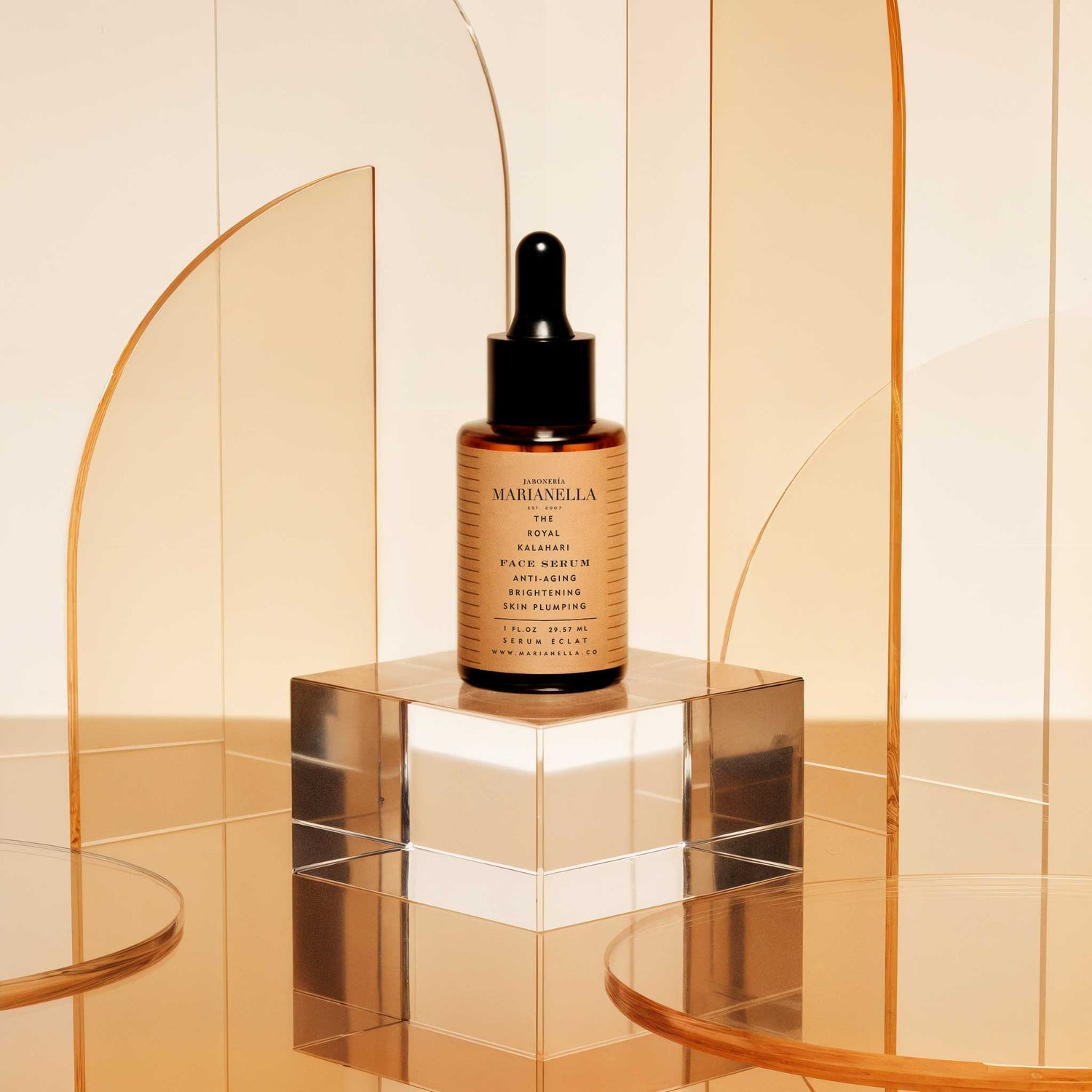
The Royal Kalahari Face Serum
The Royal Kalahari Face Serum is one of the clearest expressions of this formulation philosophy. Monoi de Tahiti oil contributes its lauric acid-driven moisture retention and anti-inflammatory action to a face serum built for visible results. The result is a formula that works across skin types, addressing dryness, uneven tone, and the structural vulnerability of a compromised barrier. $72.
Featured in Vogue, Forbes, and Oprah, and a People Magazine Star Beauty Award winner, Marianella's serums are now available at Bloomingdale's BEAUTYSPACE alongside 82 products across face, body, and home. The Royal Kalahari Face Serum represents the convergence of Venezuelan botanical heritage and the rigorous production standards that the Monoi de Tahiti Appellation of Origin demands of its sourced ingredients.
How to Use Monoi de Tahiti Oil for Skin
Application method matters as much as the formula. Monoi de Tahiti oil is a face and body versatile ingredient, but its behavior varies by context.
Face: Applied as a serum or incorporated into one, Monoi de Tahiti oil should be pressed into damp skin to maximize absorption. The fatty acid molecules require moisture to facilitate penetration past the stratum corneum. A few drops are sufficient for the full face.
Barrier repair: Tahitian Monoï is one of the best natural ingredients for dehydrated skin. Its blend of Tiaré petals and coconut oil replenishes moisture, strengthens the skin barrier, and reduces dryness caused by sun, climate, or harsh cleansers.
Seasonal use: Thanks to its nourishing power, Monoï de Tahiti protects skin from external aggressions and is a real ally for the skin against chapping and cracks caused by the cold. This gentle treatment is suitable for all skin types. It is not a summer-only ingredient. In 2026, with pollution levels and environmental aggressors at historic highs, year-round barrier support from an oil with documented antioxidant and anti-inflammatory properties is not a luxury. It is maintenance.
What to Look for When Sourcing Monoi de Tahiti
The protected designation means counterfeit and diluted versions are prevalent. Look for the words "Monoï de Tahiti, Appellation d'Origine" and the seal on the label. Check for Cocos Nucifera (Coconut) Oil and Gardenia Taitensis Flower Extract in the INCI list. If the product simply says "Monoi oil" or "Monoi fragrance," it is not the certified botanical. The chemistry will not be the same, and neither will the results.
When Monoi de Tahiti oil is formulated with the precision it deserves, by brands that understand both the source and the science, it remains one of the most quietly extraordinary ingredients in skincare. Two thousand years of use is not anecdote. It is evidence.
Explore the Royal Kalahari Face Serum and the full Marianella collection at Bloomingdale's BEAUTYSPACE or at marianella.co.
```

Dejar un comentario
Este sitio está protegido por hCaptcha y se aplican la Política de privacidad de hCaptcha y los Términos del servicio.