

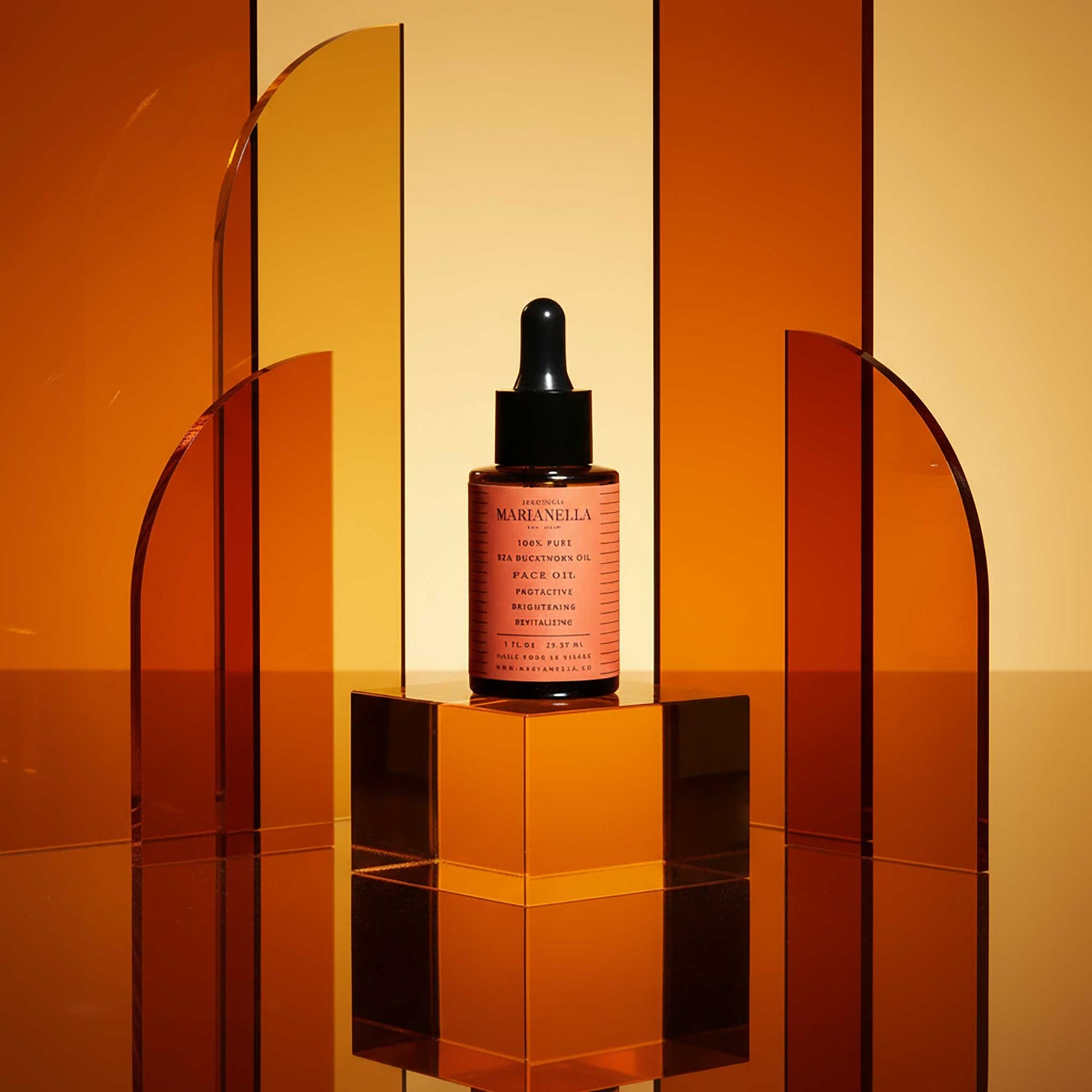
Sea buckthorn oil skincare benefits are not a matter of trend. The science behind this vivid orange botanical is among the most documented in modern cosmeceutical research, and in 2026, formulators and dermatologists are paying serious attention. Marianella's Sea Buckthorn Face Oil centers on this ingredient precisely because the data supports it, and because Marianella's 18 years of formulation expertise, rooted in three generations of Venezuelan botanical knowledge, gives the brand a particular lens for reading what botanicals can actually do for skin.
What Is Sea Buckthorn Oil?
Sea buckthorn oil is extracted from the berries, leaves, and seeds of the sea buckthorn plant (Hippophae rhamnoides), a small shrub that grows at high altitudes in the northwest Himalayan region. It has been used for thousands of years in Southeast Asia and Europe as a natural remedy for various ailments. The name Hippophae itself has ancient roots. The Greeks named it "Hippophae," meaning "horse" and "bright," as it reportedly made horses' coats shine. In Tibetan and Indian medicine, it was an ingredient in over 300 preparations by the 8th century.
What distinguishes it scientifically is its density of bioactives. Researchers have identified more than 190 active biocompounds in sea buckthorn seeds, fruit, and juice. No other botanical oil commonly used in skincare comes close to that number.
The Fatty Acid Profile That Sets It Apart
Most face oils deliver omega-3, omega-6, or omega-9 fatty acids. Sea buckthorn oil is one of the only plant foods known to provide all four omega fatty acids, including omegas 3, 6, 7, and 9. That fourth fatty acid, omega-7, is where the real differentiation lives.

Omega-7: The Skin-Identical Fatty Acid
The presence of palmitoleic acid (omega-7) is one of the features that makes sea buckthorn oil unusual among plant-derived oils. Palmitoleic acid is also naturally present in human sebum, leading researchers to consider its possible role in supporting the skin barrier and promoting epithelial repair.
The biological logic here is direct. Palmitoleic acid (omega-7) is a natural component of human sebum. Your skin produces it as part of its own lipid barrier. Starting around age 30, sebum production begins declining. By 40 and beyond, the drop accelerates noticeably. By your 40s, the sebum composition shifts toward less protective ratios, contributing to increased transepidermal water loss (TEWL) and barrier vulnerability. Topically applying an oil rich in palmitoleic acid essentially replenishes what the skin is losing.
Sea buckthorn pulp oil is dominated by palmitoleic acid (omega-7) at concentrations up to 40%, and palmitic acid (omega-9) at around 30%. For context, macadamia nut oil, one of the few other plant sources of omega-7, is found in only a few plant oils, most notably macadamia nut oil, where levels are typically lower.
Seed Oil vs. Pulp Oil: A Critical Distinction
Sea buckthorn produces two distinct oils: seed oil, extracted from the seeds, and pulp oil, extracted from the fruit flesh. Their compositions are dramatically different, and this distinction matters for skin applications. Seed oil is richer in linoleic acid (omega-6) and alpha-linolenic acid (omega-3), making it lighter, less pigmented, and better suited for oily or acne-prone skin. For anti-aging and barrier repair, pulp oil is the more clinically relevant of the two.
Sea Buckthorn Oil for Skin: What the Research Shows
The evidence base for sea buckthorn oil in skincare is not thin. A comprehensive literature review of 40 peer-reviewed studies found that sea buckthorn oil demonstrated significant anti-inflammatory, antioxidant, and immunomodulatory properties, with particular effectiveness in supporting skin barrier repair in conditions like atopic dermatitis, psoriasis, and wound healing.
Collagen and Elasticity
A 2024 randomized controlled trial published in the Journal of Functional Foods found that participants who supplemented with sea buckthorn oil for 12 weeks showed measurable improvements in skin elasticity, collagen density, pore quality, and redness compared to placebo, assessed via VISIA Complexion Analysis.
The collagen mechanism operates at the molecular level. A 2022 study published in Antioxidants examined sea buckthorn proanthocyanidins and their effect on fibroblast activity. Proanthocyanidins in sea buckthorn were found to upregulate TGF-beta-1, a key signaling protein that activates fibroblasts to produce new collagen and elastin. Separately, research also shows that sea buckthorn can degrade MMP-1 protein and enhance elastin protein expression to maintain collagen levels. Omega-7 inhibits inflammation and promotes collagen synthesis through SIRT1 activation.
Oral supplementation with sea buckthorn oil capsules resulted in decreases in mean roughness and maximum roughness of the skin surface, indicating anti-wrinkle efficacy. Topical application of sea buckthorn oil cream increased cutaneous thickness, suggesting positive structural changes and improvement in collagen synthesis in the skin.
Antioxidant Density and UV Protection
Sea buckthorn pulp oil is loaded with carotenoids, the pigments that give the berries their intense orange color, including beta-carotene, lycopene, and zeaxanthin. These carotenoids function as fat-soluble antioxidants that protect both the oil and the skin from oxidative damage.
Beyond the omegas, sea buckthorn contains an unusually high concentration of Vitamin C (up to 10x more than an orange, crucial for collagen synthesis), Vitamin A from beta-carotene, Vitamin E as a powerful antioxidant mix of tocopherols and tocotrienols, and B-complex vitamins. It also contains high levels of polyphenols, flavonoids like quercetin and kaempferol, and superoxide dismutase (SOD), one of the most powerful antioxidant enzymes found in nature.
The protective impact on UV-exposed skin is measurable. Dermatological tests showed a 20% reduction in oxidized lipids in UV-exposed skin areas treated with sea buckthorn products, indicating mitigation of premature aging (Zeb et al., 2015).
Barrier Repair and Hydration
A 2024 randomized controlled trial by Chan et al. using a sea buckthorn seed oil formulation found significant improvements in transepidermal water loss (TEWL) compared to placebo after eight weeks, confirming the barrier-strengthening mechanism.
Available evidence indicates that sea buckthorn extracts and oils have wound healing effects, enhancing collagen synthesis, tyrosinase inhibiting activity, and can act against bacteria causing acne. Human studies have confirmed increases in skin moisture, elasticity, and softness after sea buckthorn consumption.
Inflammation and Skin Conditions
Given the multifactorial nature of skin conditions such as atopic dermatitis, psoriasis, burns, and other wounds, sea buckthorn oil has attracted increasing interest as a therapeutic agent that can modulate inflammatory pathways and support skin barrier repair. The diverse array of bioactive compounds in sea buckthorn oil, including various vitamins, fatty acids, flavonoids, carotenoids, and tocopherols, suggests a powerful synergistic effect, where the overall benefit surpasses the sum of its individual parts. This multi-targeted approach addresses various skin concerns simultaneously, such as inflammation, oxidative damage, and barrier integrity, offering a significant advantage over single-active synthetic ingredients.
Why Formulation and Sourcing Matter
Sea buckthorn oil's deep orange pigment is a useful marker. The deep, rich orange color of CO2-extracted sea buckthorn fruit oil is a visual indicator of its carotenoid integrity. Sea buckthorn fruit oil is highly concentrated. Its vivid orange color means it should always be used in a blended formulation rather than neat application, both for skin tolerance and to avoid temporary staining on light skin tones or fabrics.
Not all sea buckthorn oil is equivalent. The final composition of sea buckthorn oil depends on the plant source, the part of the plant used, growing conditions, the extraction method, and the processing method. This variation is important when interpreting research or comparing skincare products. At Marianella, small-batch production in Brooklyn means every formulation is controlled at scale, with 18 years of expertise informing how botanicals are selected, blended, and stabilized.
The Marianella Sea Buckthorn Face Oil
Marianella's approach to this ingredient reflects both the science and the heritage behind the brand. Founded in 2007 by a Venezuelan botanist, Marianella draws on three generations of botanical knowledge to build formulations that are functional before they are anything else. That foundation, now visible across 82 products available at Bloomingdale's BEAUTYSPACE, recognized by People Magazine's Star Beauty Award, and covered in Vogue, Forbes, and Oprah, is what gives the Sea Buckthorn Face Oil its credibility.
The oil is formulated to deliver sea buckthorn's full bioactive profile, including its omega-7 palmitoleic acid, carotenoid antioxidant complex, and vitamin-dense fatty acid matrix, in a stable, skin-compatible concentration. It is the kind of product that earns its place in a routine not through category claims but through ingredient integrity.
Marianella Sea Buckthorn Face Oil — $46.
How to Use Sea Buckthorn Oil for Skin
Application
Warm 3 to 4 drops between palms and press gently into clean skin. Use morning or evening, after any water-based serums and before SPF in the daytime. The oil absorbs fully and does not require a long wait before layering.
Pairing
Sea buckthorn works synergistically with vitamin C, as both contribute to collagen support and antioxidant defense. It pairs well with hyaluronic acid for layered hydration. Compounds in sea buckthorn oil appear promising in protecting skin from the damaging effects of UV rays , making SPF a logical morning companion. Avoid layering immediately after high-percentage exfoliating acids. Allow a few minutes between steps for full absorption.
Who It Is For
Sea buckthorn oil suits dry, mature, and barrier-compromised skin most directly. Seed oil, richer in linoleic acid (omega-6) and alpha-linolenic acid (omega-3), is better suited for oily or acne-prone skin. For combination skin, consider alternating or using a lighter application in the T-zone. The comedogenic rating sits at 2 on a 0-to-5 scale, a low clogging risk even for combination skin.
Sea Buckthorn in 2026: Where the Ingredient Stands
The worldwide interest in sea buckthorn is reflected in the market value that continues to rise, estimated for strong growth from USD 1,153.1 million in 2025 to USD 3,800.7 million by 2035. This growth is largely attributed to growing consumer preference toward natural multitasking skincare ingredients and increasing scientific evidence of sea buckthorn's therapeutic efficacy.
In 2026, the ingredient sits at a meaningful intersection: deep historical use across Asian and European traditional medicine, a growing body of peer-reviewed clinical evidence, and genuine biochemical uniqueness in its complete omega profile and bioactive density. Sea buckthorn fruit oil addresses the three primary mechanisms of skin aging simultaneously: collagen degradation, oxidative stress, and declining cell turnover. Few single botanical ingredients accomplish that.
Marianella has spent 18 years working with ingredients that earn their place in a formulation. Sea buckthorn oil is one of them.
Explore the Marianella Sea Buckthorn Face Oil and the full 82-product range at marianella.co and at Bloomingdale's BEAUTYSPACE.
```


Hinterlasse einen Kommentar
Diese Website ist durch hCaptcha geschützt und es gelten die allgemeinen Geschäftsbedingungen und Datenschutzbestimmungen von hCaptcha.