

Vitamin E Skincare Benefits: What the Science Actually Says in 2026
Vitamin E for skin is not a trend. It is one of the most extensively studied topical actives in dermatology, with a research record spanning more than six decades. Vitamin E is an important fat-soluble antioxidant that has been in use for more than 50 years in dermatology. What keeps it relevant is not marketing. It is molecular function. Vitamin E works at the level of the cell membrane, the skin barrier, and the body's own antioxidant network in ways that newer, heavily hyped actives are still trying to replicate.
At Marianella, formulated in Brooklyn since 2007, vitamin E is one of the foundational actives across our 82-product line. Three generations of Venezuelan botanical knowledge inform how we select and pair it. Here is what the science says, and why the ingredient earns its place in every serious skincare routine in 2026.
What Is Vitamin E? A Definition for Skin Science
Vitamin E is a group of fat-soluble vitamins with antioxidant effects. Vitamin E was discovered at the University of California at Berkeley in 1922, and eight vitamin E isoforms with biological activity have been isolated from plant and animal sources. In skincare, the form most commonly used and most well-studied is alpha-tocopherol, the most biologically active of those eight isoforms.

|
$50 |

|
$84 |

|
$32 |

|
$29 |
Tocopherol, with alpha-tocopherol being the most potent form, has effects in the skin including antioxidant activity, improved membrane stability, protection against UV radiation, moisturizing action on dry skin, and anti-inflammatory action. Its name gives away its origin: in 1936, vitamin E was biochemically characterized and named tocopherol from the Greek "tocos," meaning offspring, and "phero," meaning to bring forth.
What distinguishes vitamin E from other antioxidants is its lipid solubility. It situates itself directly inside fatty cell membranes, which is precisely where oxidative damage begins.
How Vitamin E Works in the Skin
Free Radical Defense at the Cell Membrane
Vitamin E is the major naturally occurring lipid-soluble non-enzymatic antioxidant protecting skin from the adverse effects of oxidative stress, including photoaging. Antioxidants fight free radicals, which are electrons that have broken off from an atom. Left unchecked, those free radicals accelerate collagen degradation, disrupt the skin barrier, and contribute to visible aging.
The antioxidant property of vitamin E is exerted through the phenolic hydroxyl group, which readily donates its hydrogen to the peroxyl radical, resulting in the formation of a stable lipid species. In practical terms, this means vitamin E intercepts oxidative chain reactions before they can degrade the structural proteins that keep skin firm and even-toned.
Tocopherol has also been shown to play a role in maintaining the structural integrity of cell membranes and connective tissue. Firmness, texture, and tone are maintained by the integrity of the elastic fiber in the dermis and collagen in connective tissue.
The Skin Barrier Connection
A series of studies investigating non-enzymatic stratum corneum antioxidants have demonstrated that vitamin E is the predominant physiological barrier antioxidant in human skin. This is a significant finding. The stratum corneum, the outermost layer of the epidermis, is the front line of environmental defense, and vitamin E is its primary endogenous antioxidant.
After topical application, vitamin E accumulates not only in cell membranes but also in the extracellular lipid matrix of the stratum corneum, where it contributes to antioxidant defenses. Vitamin E is also believed to improve the hydration of the skin, and insufficiently hydrated skin is characterized by lines at relatively closer distance than in normal skin, irregular texture, and a rough appearance.
Photoprotection: What the Research Shows
Vitamin E skincare benefits are perhaps most supported by photoprotection research. Vitamin E can absorb the energy from ultraviolet UV light, and it plays important roles in photoprotection, preventing UV-induced free radical damage to skin.
The largest body of scientific evidence for a beneficial role of topical vitamin E exists for photoprotection. Vitamin E provides protection against UV-induced skin photodamage through a combination of antioxidant and UV absorptive properties. That said, although molecules in the vitamin E family can absorb light in the UVB spectrum, the primary photoprotective effect of vitamin E is attributed to its role as a lipid-soluble antioxidant , making it a complement to, not a replacement for, broad-spectrum SPF.
Inflammation and Skin Conditions
Research has found lower vitamin E levels in patients with vitiligo, psoriasis, atopic dermatitis, and acne compared to healthy controls. This association points to the ingredient's broader role in skin-level inflammation modulation. Vitamin E is attributed with pharmacological properties including antioxidant action, anti-inflammatory effects, and skincare benefits.
The Vitamin C and Vitamin E Synergy
Used alone, vitamin E delivers real results. Paired with vitamin C, it performs on a different level. This is one of the most established pairings in evidence-based skincare.
Vitamins E and C work in tandem in the skin through a chain antioxidant mechanism. Vitamin E, located in lipid membranes, is the first to neutralize free radicals generated by UV radiation. In the process, it becomes oxidized and is converted into a less active radical form called the tocopheryl radical. Vitamin C, present in the aqueous phase, donates an electron to the tocopheryl radical, regenerating vitamin E to its active form.
The practical result: products containing both vitamin C and vitamin E have shown greater efficacy in photoprotection than either antioxidant alone. Ferulic acid incorporated into a topical solution of vitamin C and 1% alpha-tocopherol improves the chemical stability of both vitamins and doubles photoprotection to solar-stimulated irradiation of skin.
The combination of lipid-soluble vitamin E and water-soluble vitamin C provides comprehensive antioxidant coverage to protect all portions of skin cells from oxidative attacks. This is why high-performance serums prioritize both, not one or the other.
Vitamin E Beyond Antioxidant Function
The science of vitamin E has moved beyond its antioxidant reputation. Beside an antioxidant role, important cell signaling properties of vitamin E have been described. Alpha-tocopherol regulates signal transduction cascades not only at the mRNA level but also at the miRNA level, since miRNA 122a involved in lipid metabolism and miRNA 125b involved in inflammation are downregulated by alpha-tocopherol.
Decades of research on the vitamin E family have shown diverse biological activities such as antioxidant, anti-inflammatory, anticancer, neuroprotective, and skin protection benefits. The emerging picture is of an ingredient whose value to the skin is structural, biochemical, and epigenetic at once.
How to Choose the Best Vitamin E Products in 2026
Not all vitamin E formulations deliver equally. Topically applied vitamin E, either in the alcohol or the acetate form, can be absorbed through the skin. The form of vitamin E, the delivery system, and what it is paired with all determine whether the ingredient performs or sits inert in the formula.
One of the most studied pairings is vitamin E with vitamin C, due to vitamin C's role as a primary replenisher of vitamin E in skin. Vitamin C regenerates the oxidized form of vitamin E to its reduced form. For consumers, this means looking for serums and treatments that pair the two, rather than products featuring vitamin E in isolation.
Concentration matters. Formula stability matters. And the carrier matters. Vitamin E in a lightweight serum penetrates differently than the same ingredient suspended in a heavy cream. Marianella's 18 years of small-batch formulation in Brooklyn shape how the ingredient shows up in every product below.
Marianella Products Featuring Vitamin E
For Daily Antioxidant Defense
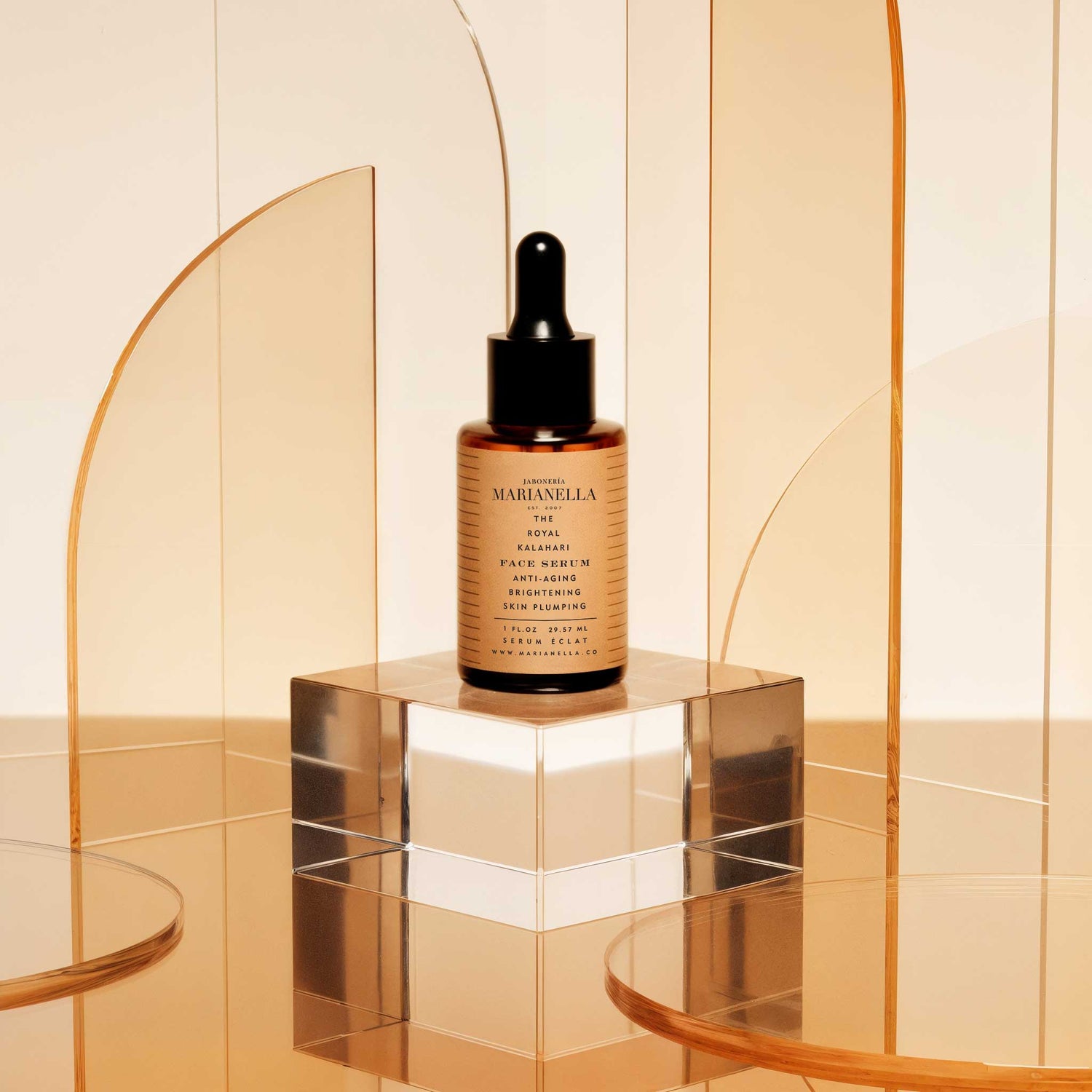
The Royal Kalahari Face Serum brings vitamin E into a lightweight daily serum built for environmental defense. Rooted in Venezuelan botanical heritage and handcrafted in Brooklyn, it draws on 18 years of formulation expertise to deliver antioxidant protection in a format the skin can absorb readily. $50.
For Advanced Anti-Aging Results
The Wrinkle Reducing Ultra Peptide Intensive Face Serum combines vitamin E with peptide technology for a serum designed to address visible aging at a structural level. The antioxidant action of vitamin E pairs with peptide signals to support skin that looks and behaves younger. People Magazine Star Beauty Award winner. As seen in Vogue, Oprah, and Forbes. $84.
For the Eye and Lip Area
The Royal Kalahari Under Eye and Lip Serum Roller Oil delivers vitamin E in a targeted roller format, placing antioxidant and moisturizing support precisely where the skin is thinnest and most vulnerable to oxidative stress. Available now at Bloomingdale's BEAUTYSPACE. $32.
For a Cleanse That Does More
The Detox Gel now with Kalahari Melon Seed Oil brings vitamin E into the first step of any skincare routine, combining detoxifying action with antioxidant support so that cleansing does not strip the barrier it should be strengthening. $29.
Who Needs Vitamin E for Skin
The honest answer is most people. A study analyzing dietary data from almost 10,000 individuals suggests that the majority of men and women in the United States fail to meet current recommendations for vitamin E intake. What the body does not supply adequately through diet, topical application can help address at the skin surface directly.
Those dealing with dryness, uneven tone, environmental stress, or early signs of aging will find the most pronounced results. Sensitive skin types benefit from the anti-inflammatory dimension of the ingredient. Anyone spending time outdoors should consider it a non-negotiable layer of antioxidant defense beneath SPF.
The Formulation Perspective
Marianella's approach to vitamin E reflects three generations of Venezuelan botanical tradition applied through 18 years of handcrafted formulation in Brooklyn. That means ingredient sourcing is deliberate, batch sizes stay small, and every pairing in the formula has a purpose grounded in both plant knowledge and current skin science.
Many studies document that vitamin E occupies a central position as a highly efficient antioxidant, thereby providing possibilities to decrease the frequency and severity of pathological events in the skin. That is the standard Marianella holds formulations to: not vitamin E as a label claim, but vitamin E as a functioning, strategically paired active in every product that carries it.
Browse the full Marianella lineup at marianella.co and at Bloomingdale's BEAUTYSPACE. If you have questions about which product fits your skin concern, the team is available to help you find the right place to start.
```

Hinterlasse einen Kommentar
Diese Website ist durch hCaptcha geschützt und es gelten die allgemeinen Geschäftsbedingungen und Datenschutzbestimmungen von hCaptcha.