

Vitamin C skincare benefits are among the most thoroughly documented in dermatology. If you are looking for a single ingredient that addresses brightening, collagen production, antioxidant defense, and uneven skin tone, the science consistently points here. In 2026, it remains the benchmark active for results-driven formulations, and Marianella has built several of its most awarded serums around it.
What Is Vitamin C in Skincare?
Vitamin C is a powerful water-soluble antioxidant, and its chemically active form is L-ascorbic acid (LAA), which is why it is used extensively in dermatology practice. It is found naturally in citrus fruits, kiwi, and a range of botanical sources that have been central to beauty traditions across cultures for generations. In a topical formulation, it works at the cellular level to protect, repair, and rebuild.
The function of vitamin C is mostly linked to its electron-donating property, which powers several biological processes, including protection against reactive oxygen species (ROS) and the hydroxylation reactions essential for collagen synthesis. This is the chemistry behind every result you see on skin.
The Science of Vitamin C for Skin
Collagen Synthesis: The Core Mechanism
L-ascorbic acid is an essential cofactor for lysyl hydroxylase and prolyl hydroxylase, the enzymes essential for collagen biosynthesis. It also preferentially stimulates collagen synthesis in a manner that appears unrelated to its role in hydroxylation reactions. In practical terms, this means vitamin C contributes to collagen building through more than one pathway simultaneously.

|
$50 |

|
$84 |

|
$50 |

|
$32 |
Ascorbic acid is a potent stimulator for Type I and Type III collagen expression in human skin fibroblasts. Nuclear run-on experiments demonstrated that ascorbic acid enhanced the transcription of Type I and Type III collagen genes 4-fold and 3.4-fold respectively. The results confirm that ascorbic acid preferentially enhances these specific collagen gene transcriptions. These are the collagen types most responsible for skin firmness and structural integrity.
After prolonged exposure to ascorbate, collagen synthesis in cultured human skin fibroblasts increased approximately 8-fold with no significant change in synthesis of noncollagen protein. That specificity is what makes vitamin C so valued by formulators working at a serious level.
Vitamin C prevents the breakdown of collagen and stimulates its growth, which prevents and repairs photodamaged skin. This dual action, both building new collagen and protecting existing structures, is why it appears in anti-aging and brightening formulas alike.
Antioxidant Protection and Photodefense
In the aging process and in reactive skin, the role of reactive oxygen species must be considered. The skin, as the external surface of the body, is constantly exposed to UV radiation, which leads to the production of ROS. Vitamin C intercepts this damage before it translates into visible aging.
In one of the classic vitamin C studies conducted on pig skin, twice as much UV was needed to turn skin red after it was treated with 15% ascorbic acid. Adding 1% vitamin E doubled that protection, and adding 0.5% ferulic acid doubled it again, resulting in a total of 8 times the UV protection. This is the foundation behind combining vitamin C with complementary antioxidants in high-performance serums.
Studies show that when you combine vitamin C with sunscreen, you get even better sun protection and sun aging protection because they work together. Applying vitamin C in the morning, before SPF, amplifies daily defense.
Brightening and Hyperpigmentation
Vitamin C interacts with copper ions at tyrosinase-active sites and inhibits the action of the enzyme tyrosinase, the main enzyme responsible for the conversion of tyrosine into melanin, thereby decreasing melanin formation. This is how it addresses dark spots at the source rather than simply covering them.
In one study, 73% of participants saw an improvement in their hyperpigmentation while using topical vitamin C. Results begin to appear with consistency. Most people see initial brightening within 4 to 6 weeks of consistent use, with concentrations between 10 and 20% providing the best balance of effectiveness and tolerability.
Dark Circles and Under-Eye Skin
A study showed that vitamin C helped improve dark under-eye circles caused by pooled blood. The under-eye area is where collagen loss and oxidative stress show first, making targeted vitamin C application around the orbital zone a practical priority for most skin concerns.
Formulation Matters: Why Not All Vitamin C Products Perform Equally
The gap between a vitamin C product that works and one that sits in your cabinet oxidizing is formulation science. This is where 18 years of handcrafted formulation expertise in Brooklyn matters.
Among all forms, L-ascorbic acid is the most biologically active and well studied. It is a hydrophilic and unstable molecule, and reducing the acidity of L-ascorbic acid to a pH below 3.5 is an effective method of improving its stability and permeability.
The most effective vitamin C formulations contain 15% L-ascorbic acid, 1% vitamin E, and 0.5% ferulic acid, while strengths ranging from 5% to 20% are considered safe. Concentration alone does not determine efficacy. Packaging, pH, and synergistic stabilizers all determine whether the vitamin C in a formula remains active when it reaches skin.
Studies have tested ascorbic acid at concentrations between 3% and 25%. Higher percentages tend to be more irritating, and low percentages are underrated. A significant body of research has been conducted at 3% and 5% ascorbic acid, confirming that you do not necessarily need high concentrations to see meaningful results.
The Vitamin C and Niacinamide Combination
The misconception that you should not use niacinamide and vitamin C together originates from outdated studies conducted in the 1960s. These early studies suggested that combining the ingredients could cause instability or irritation in certain formulations. That guidance no longer holds.
Modern skincare science has advanced significantly since then. Recent studies show that when formulated correctly, both ingredients can coexist stably and effectively, enhancing each other's benefits.
Using vitamin C and niacinamide together offers powerful benefits: vitamin C reduces hyperpigmentation while niacinamide evens skin tone and minimizes dark spots. Vitamin C boosts collagen for smoother skin while niacinamide strengthens the skin barrier. Niacinamide also calms irritation, helping to mitigate potential sensitivity from vitamin C. The two ingredients address the same concerns through different mechanisms, which is why they perform better together than apart.
Vitamin C for Skin in the Marianella Lineup
Marianella was founded in 2007 by a Venezuelan-born formulator, drawing from three generations of botanical beauty knowledge. That heritage is not decorative. Venezuelan botanicals have long provided the antioxidant scaffolding around which effective actives like vitamin C can work. Every product below is made small-batch in Brooklyn, featured in Vogue, Forbes, Oprah, and Allure, and earned Marianella a People Magazine Star Beauty Award. All are available now at Bloomingdale's BEAUTYSPACE.
Vitamin C Collagen Boosting Face Serum with Niacinamide
This is the most direct expression of the vitamin C and niacinamide science. The formula puts both actives together in a single serum, targeting hyperpigmentation, dullness, and loss of firmness through complementary mechanisms. It addresses the collagen-synthesis pathway that ascorbic acid is clinically proven to activate, while niacinamide supports the skin barrier and evening of tone. Vitamin C Collagen Boosting Face Serum with Niacinamide, $50.
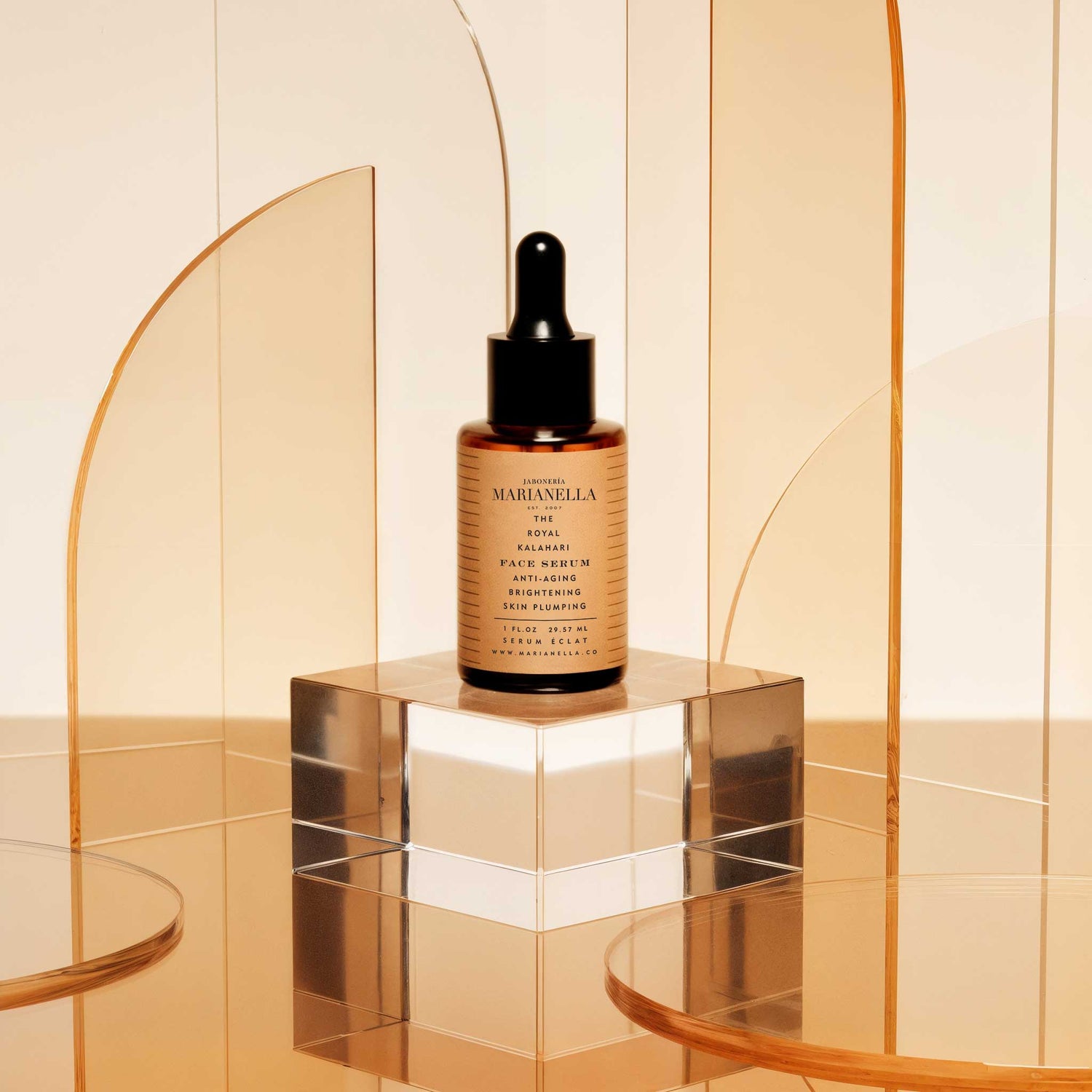
The Royal Kalahari Face Serum
Marianella's Royal Kalahari line draws on Kalahari Desert botanicals known for extraordinary resilience and antioxidant density, layered with the proven vitamin C skincare benefits that address photoaging, uneven tone, and skin texture. This serum reflects the brand's approach of pairing heritage plant intelligence with active ingredient science. The Royal Kalahari Face Serum, $50.
Wrinkle Reducing Ultra Peptide Intensive Face Serum
Peptides and vitamin C share a common goal: collagen. Peptides signal the skin to produce more; vitamin C provides the biochemical cofactors that make collagen synthesis structurally possible. This intensive formulation brings both together for skin that is visibly firmer and more resistant to the breakdown of UV exposure and daily oxidative stress. For anyone focused on fine lines and loss of density, this is the most concentrated option in the Marianella vitamin C range. Wrinkle Reducing Ultra Peptide Intensive Face Serum, $84.
The Royal Kalahari Under Eye and Lip Serum Roller Oil
The under-eye zone is where collagen depletion and oxidative stress become visible first. A targeted formula with vitamin C directly addresses the pigmentation and structural changes that manifest as dark circles and fine lines in this area. The roller delivery makes precise application practical without tugging at delicate periorbital skin. The Royal Kalahari Under Eye and Lip Serum Roller Oil, $32.
How to Use Vitamin C: Practical Guidance
Morning Is the Right Time
Application of vitamin C prior to sunscreen in the morning is most advantageous, whereas retinol use at night is preferred to avoid photosensitivity. This sequencing turns your morning routine into a layered antioxidant defense, with vitamin C intercepting free radical damage as it is generated throughout the day.
Apply to Clean Skin First
It is advisable to apply ascorbic acid as close as possible to bare skin, since the molecule is not optimally efficient at absorbing through additional product layers. Cleanse, then apply vitamin C before moisturizer and SPF.
Give It Time
Vitamin C typically shows initial brightening within 2 to 4 weeks, with significant improvement by 8 to 12 weeks. Consistency over that window is what separates results from disappointment. The collagen-level changes that produce real structural improvement happen at the cellular level over months, not days.
Store It Correctly
L-ascorbic acid degrades primarily through oxidation, a process accelerated by several factors: exposure to oxygen, UV radiation, and elevated temperatures. Keep vitamin C serums away from direct light and heat, and replace when the color shifts to deep orange or brown, which signals oxidation.
The Bottom Line on Vitamin C Skincare Benefits in 2026
Vitamin C for skin is not a trend. It is one of the most researched topical ingredients in dermatology, with a body of clinical evidence spanning collagen biosynthesis, antioxidant defense, melanin inhibition, and photoprotection. The science has not changed. What has evolved is the formulation intelligence applied to it.
Marianella brings 18 years of small-batch formulation expertise, Venezuelan botanical heritage, and a commitment to ingredient integrity to every product in the lineup. If you are building a routine around real results, vitamin C is where the science starts. Explore the full Marianella vitamin C range to find the formula suited to your skin.
```


Hinterlasse einen Kommentar
Diese Website ist durch hCaptcha geschützt und es gelten die allgemeinen Geschäftsbedingungen und Datenschutzbestimmungen von hCaptcha.