

Jojoba oil skincare benefits go far beyond basic moisture. This botanically sourced liquid wax, pressed from the seeds of Simmondsia chinensis, is one of the most structurally intelligent ingredients in modern formulation science, and in 2026, the research supporting it is more rigorous than ever. Jojoba oil is not a conventional oil, but a liquid wax ester, comprising approximately 98% long-chain monounsaturated esters, structurally similar to human sebum. That single fact explains most of what makes it remarkable on skin.
What Is Jojoba Oil? A Formulator's Definition
Jojoba (Simmondsia chinensis) oil is a transparent yellow liquid that is generally categorized as "oil" but is actually a liquid wax ester. Unlike vegetable oils and animal fats, jojoba oil is not a triglyceride but a mixture of long chain esters (97–98%) of fatty acids and fatty alcohols. Most botanical oils are built from triglycerides. Jojoba is structurally distinct, and that distinction is everything.
Jojoba seeds contain 48–53% liquid wax, comprised of fatty esters. The wax's chemical composition includes C16–C24 fatty acids and fatty alcohols, resembling the human skin's natural sebum, which consists of 2–30% wax esters. It also contains tocopherols, as well as high levels of phytosterols. These compounds do measurable work at the skin surface level, from barrier reinforcement to antioxidant activity.
Modern research underscores jojoba oil's pharmacological versatility, demonstrating antioxidant, antidiabetic, anti-acne, anti-inflammatory, antipyretic, and antibacterial properties. The scope of its activity has made it a favored ingredient across pharmaceutical, cosmeceutical, and luxury skincare formulation alike.
Why Jojoba Oil Works on Skin: The Science
Structural Compatibility with Human Sebum
The reason jojoba oil for skin is so widely trusted by dermatologists and formulators comes down to chemistry. The esters in jojoba oil are similar to human skin sebum and are esters of fatty alcohol with long monounsaturated fatty acid chains. Its composition is similar to human sebum, which contains cholesterol esters (2%), cholesterol (4%), squalene (10%), wax esters (25%), free fatty acids (28%), and triglycerides (33%). When an ingredient mirrors your skin's own lipid architecture, the skin does not resist it. It absorbs and integrates it.

|
$112 |

|
$50 |
This rare molecular profile grants jojoba oil exceptional oxidative stability, a low comedogenic profile, and enhanced dermal absorption. For formulators working with active ingredients, that delivery profile is not incidental. It is the point.
Barrier Reinforcement and Moisture Retention
Jojoba seeds contain about 50% of liquid wax, which is mainly used in cosmetic preparations, not only acting as a humectant, but creating a protective film over the skin that keeps in moisture. This dual action, drawing moisture while forming an intelligent occlusive layer, makes it one of the more effective barrier-support ingredients in botanical skincare.
Jojoba wax may form an efficient barrier that protects the skin surface, retaining moisture in the skin, as determined by transepidermal water loss evaluation. Transepidermal water loss (TEWL) is one of dermatology's key markers for barrier health. Lower TEWL means the skin is holding hydration rather than surrendering it to the environment.
Collagen and Hyaluronic Acid: New Research from 2024
One of the most significant recent findings comes from a 2024 study published in Frontiers in Pharmacology, using an ex-vivo human skin organ culture model. mRNA and protein levels of collagen III and synthesis of hyaluronic acid were markedly increased upon topical application of jojoba. The enhanced content of extracellular matrix (ECM) components correlated with the enhanced expression of TGFβ1.
The finding that topical application of jojoba wax enhances the synthesis of pro-collagen and hyaluronic acid may be beneficial in the treatment of age-related manifestations. This positions jojoba not merely as a moisturizing carrier, but as an active participant in skin structure support. For an anti-aging night cream or a peptide-forward formulation, that distinction matters.
Anti-Inflammatory Activity
Extensive studies on jojoba oil showed a wide range of pharmacological applications, including antioxidant, anti-acne and anti-psoriasis, anti-inflammatory, antifungal, antipyretic, analgesic, antimicrobial, and anti-hyperglycemia activities. Its anti-inflammatory properties make it relevant not only for sensitive skin types, but also for post-treatment skin, acne-prone skin, and any formulation designed to work at the skin barrier level.
Jojoba oil has anti-inflammatory effects, anti-skin-aging effects, wound healing effects, antioxidant effects, antibacterial effects, and antifungal effects. That is a meaningful breadth of activity from a single botanical source.
A Brief History: From Desert Medicine to Brooklyn Small-Batch
Traditionally, jojoba wax, as crushed seeds, was used by native Americans of Baja California for skincare, including treatment of cuts, sores, bruises, and burns, including sun and windburn, or hair lubrication. Its seeds and oil have ancient roots in folk medicine, used for treating skin and scalp issues, wounds, sore throats, obesity, and even cancer, while enhancing immunity and fostering hair growth. Long before it appeared in luxury formulations, indigenous communities understood what the skin responds to.
At Marianella, that respect for botanical heritage is structural. Founded in 2007 by a Venezuelan-born formulator, the brand carries three generations of South American botanical knowledge into a small-batch production studio in Brooklyn. The same rigor applied to selecting traditional botanicals like jojoba, where the molecular evidence now confirms what experience long suggested.
Jojoba Oil in Marianella Formulations
With 18 years of formulation expertise and 82 products across face, body, and home, Marianella integrates jojoba oil where its properties are most strategically deployed: in overnight and intensive repair formulas where barrier support, delivery enhancement, and skin-structure activity can all work in concert.
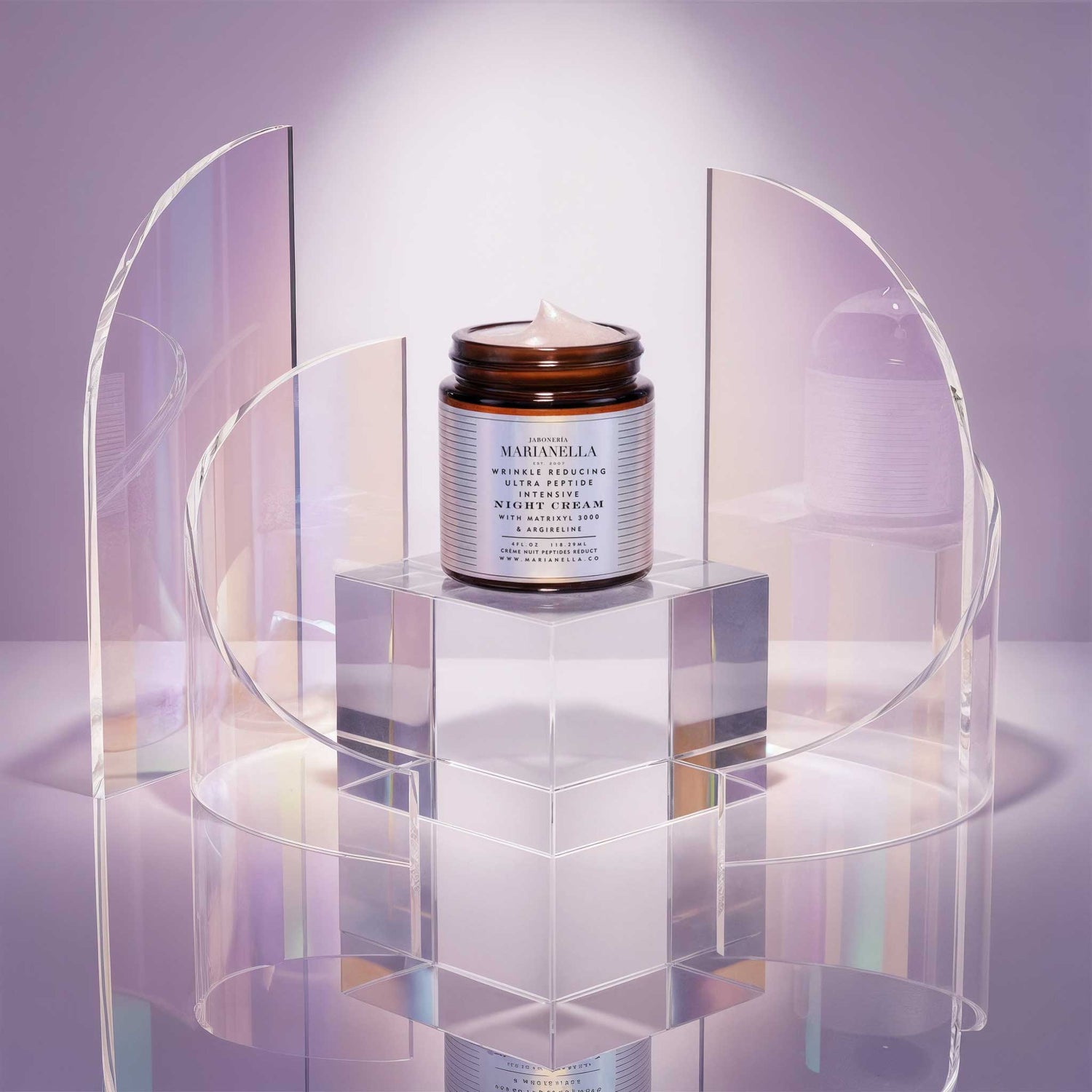
Wrinkle Reducing Ultra Peptide Intensive Night Cream
Night is when the skin's regenerative activity peaks, making ingredient selection at this hour particularly consequential. Jojoba oil's low comedogenic profile and structural affinity with skin sebum make it an ideal vehicle in a peptide-forward overnight formula. The lipid architecture of jojoba supports ingredient penetration while reinforcing the barrier through the hours when TEWL is naturally highest. The Wrinkle Reducing Ultra Peptide Intensive Night Cream is $112.
The Midnight Youth Potion
A concentrated overnight treatment built around the same philosophy: what goes on skin at night should work with the skin's biology, not against it. Jojoba's documented ability to support collagen III synthesis and hyaluronic acid production, as confirmed in the 2024 Frontiers in Pharmacology study, makes it a fitting anchor in a formula designed for visible overnight recovery. The Midnight Youth Potion is $50.
Both formulas are handcrafted in small batches in Brooklyn, held to the same standard of botanical precision that earned Marianella the People Magazine Star Beauty Award and placement in Vogue, Oprah, Forbes, Allure, and WWD. Now available at Bloomingdale's BEAUTYSPACE.
Who Should Use Jojoba Oil for Skin
All Skin Types, Including Oily and Acne-Prone
The noncomedogenic designation is not marketing language. Jojoba oil's rare molecular profile grants it a low comedogenic profile and enhanced dermal absorption, meaning it does not sit on the skin surface the way heavier triglyceride-based oils can. Because its esters so closely mirror human sebum, it does not trigger the overproduction response that many other oils do on oily or congestion-prone skin.
Modern research underscores jojoba oil's pharmacological versatility, demonstrating antioxidant, antidiabetic, anti-acne, anti-inflammatory, antipyretic, and antibacterial properties. Anti-acne and anti-inflammatory in one ingredient is a rare overlap.
Sensitive and Compromised Skin
The chemical structure of the jojoba wax bears strong similarity to the monoesters known to exist in human sebum and excreted by the sebaceous glands. Jojoba esters are highly compatible with human skin and can help to mimic the benefits of components of skin sebum. For skin dealing with sensitization, environmental stress, or a disrupted barrier, that compatibility matters.
Mature Skin
The 2024 collagen and hyaluronic acid data is particularly relevant for mature skin, where both are in natural decline. mRNA and protein levels of collagen III and synthesis of hyaluronic acid were markedly increased upon topical application of jojoba. The enhanced content of extracellular matrix (ECM) components correlated with the enhanced expression of TGFβ1. ECM support is foundational to skin firmness and surface texture.
What to Look for in the Best Jojoba Oil Products in 2026
Not all jojoba-forward formulas are equal. The best jojoba oil products in 2026 will combine cold-pressed or minimally processed jojoba with complementary actives. Pairing jojoba with peptides, as Marianella does in both featured formulas, leverages its delivery properties. Pairing it with antioxidants leverages its compatibility with the skin's own lipid system without competition. Packaging matters too. Jojoba esters are very resistant to oxidation, more so than castor oil, coconut oil, macadamia oil, even many fractions of mineral oil. But formulations that combine jojoba with more oxidation-sensitive ingredients should still prioritize airless or opaque packaging.
Look for brands with documented formulation expertise and a clear sourcing philosophy. Eighteen years of botanical formulation work, anchored in a specific cultural and geographic tradition of plant-based skincare, is not a marketing claim. It is a methodology. That methodology shows in how the ingredient is used, not just that it appears on a label.
The Takeaway
Jojoba oil's position in serious skincare is earned by science, not trend. There has been a surge in its utilization in pharmaceuticals, particularly in topical, transdermal, and parenteral formulations. When pharmaceutical-grade research converges with luxury formulation, the ingredient deserves attention. In the context of a well-designed overnight formula, jojoba works at multiple levels simultaneously: delivering actives, supporting the barrier, reducing inflammation, and now, based on 2024 research, actively participating in collagen and hyaluronic acid synthesis.
Marianella's Wrinkle Reducing Ultra Peptide Intensive Night Cream ($112) and The Midnight Youth Potion ($50) are both available at marianella.co and at Bloomingdale's BEAUTYSPACE. If you want to understand what an ingredient does before you put it on your skin, that is exactly the right instinct. Jojoba has the science to support the conversation.
```


Hinterlasse einen Kommentar
Diese Website ist durch hCaptcha geschützt und es gelten die allgemeinen Geschäftsbedingungen und Datenschutzbestimmungen von hCaptcha.