

Glycerin skincare benefits are well-documented, extensively studied, and genuinely remarkable, which is why this single molecule appears in products ranging from basic drugstore lotions to precision-formulated luxury serums. Glycerin is one of the most effective and widely used moisturizing ingredients in skincare. It works as a humectant, meaning it pulls water into your skin's outer layers and holds it there. In 2026, as consumers demand more scientific transparency from their beauty brands, glycerin remains the gold standard, the quiet anchor behind high-performance hydration. At Marianella, it anchors several of the brand's most clinical formulas, each handcrafted in Brooklyn using 18 years of formulation expertise.
What Is Glycerin? A Precise Definition
Also known by its IUPAC name, propane-1,2,3-triol, glycerin is comprised of three hydrophilic hydroxyl groups on a 3-carbon backbone. It is a type of "polyol," a chemical with multiple alcohol functional groups. Those hydroxyl groups make this compound miscible with water. Glycerin is also hygroscopic, meaning it has an affinity for water so high that it actually absorbs water from its environment.
Glycerin has been used in cosmetic skincare formulas for the past one hundred years. It is in the top three most common cosmetic ingredients, after water and fragrance. That longevity is not inertia. It is earned. No ingredient survives a century of evolving formulation science unless it consistently delivers.
The Molecular Science Behind Glycerin for Skin
The molecular structure of glycerin explains why it works so well in skincare. This trihydroxy alcohol contains three hydroxyl groups that create strong hydrogen bonds with water molecules, which makes it an exceptional humectant. At a molecular weight of just 92 daltons, glycerin is small enough to penetrate deep into skin layers.

|
$84 |

|
$50 |

|
$112 |
Glycerin functions like a microscopic sponge, pulling water from deeper skin layers and the surrounding environment to the skin's surface. Pure glycerin demonstrates exceptional moisture-retention capacity, absorbing its own weight in water over three days.
Concentration matters significantly. Research published in Scientific Reports found that the moisture-retention capacity of glycerin increased with concentration from 0 to 60 wt%, and glycerin at a concentration of 60 to 70 wt% did not exhibit weight change during the evaporation process. When the glycerin concentration exceeded 70 wt%, moisture sorption occurred in the glycerin solution. In practical skincare formulations, staying below that threshold ensures the ingredient retains rather than draws moisture away from the skin surface.
Glycerin and Aquaporin-3: The Cellular Transport Mechanism
The most compelling science around glycerin for skin goes deeper than surface hydration. Aquaporin-3 (AQP3) is a membrane transporter of water and glycerol expressed in plasma membranes in the basal layer keratinocytes of epidermis in normal skin. This is the cellular channel through which glycerin enters the skin.
Your skin contains a natural transport system for moving water and small molecules through cells. A key part of this system is a protein called aquaporin-3, found in the deepest layer of your epidermis. This protein acts like a channel, shuttling both water and glycerol, glycerin's naturally occurring form, into skin cells.
The significance of this pathway becomes clear in knockout studies. AQP3-knockout mice have reduced stratum corneum water content and elasticity compared with wild-type mice, as well as impaired wound healing and epidermal biosynthesis. AQP3 knockout mice exhibit an epidermal phenotype characterized by dry skin, decreased elasticity, and delayed barrier repair and wound healing, which can be corrected by glycerol but not other humectants. That last detail is significant. Glycerin is not interchangeable with other moisture-binding molecules.
Proven Glycerin Skincare Benefits, Backed by Clinical Evidence
Deep and Lasting Hydration
In clinical studies, skin treated with glycerin maintained significantly higher hydration levels compared to untreated skin or skin treated with a plain base cream. More telling is what happens after treatment stops. Seven full days after treatment stopped, the glycerin-treated skin still showed significantly higher hydration and better barrier function than untreated areas. That persistence suggests glycerin does not just mask dryness temporarily. It stabilizes the skin barrier in a way that compounds over time with regular use, which is why dermatologists often recommend glycerin-based moisturizers for people with chronically dry or irritation-prone skin.
Head-to-head comparisons also favor glycerin. A study revealed that 10% glycerin performed better than both 10% propylene glycol and 10% urea in providing skin hydration over three hours.
Skin Barrier Support
Glycerin has a small molecular size, so it penetrates the stratum corneum, your skin's outermost layer, with ease. Once inside, it helps support the lipid matrix, the structural glue between skin cells that keeps your barrier intact, pliable, and your hydration levels steady.
AQP3-mediated glycerol transport plays an important role in stratum corneum hydration, skin elasticity, barrier recovery, wound healing, and cell proliferation. When the barrier is intact, moisture stays in and environmental aggressors stay out.
Visible Anti-Aging Effects
As a humectant, glycerin draws moisture from the air to the skin, helping to keep skin hydrated and plump, therefore reducing the appearance of fine lines and wrinkles. The mechanism is straightforward: chronically dehydrated skin loses structural volume, making lines appear deeper. Restoring and sustaining hydration at the cellular level reverses that visual compression.
Loss of skin hydration engenders skin dryness, wrinkling, sagging, and laxity. Glycerin addresses the root of this cascade rather than smoothing over the symptoms.
Cell Renewal and Skin Smoothness
Research has explored glycerin's role in helping organize lipids in the skin barrier. Some findings suggest glycerin may assist in the natural shedding process, known as desmosomal degradation, which helps keep skin smooth and less flaky. Healthy cell turnover is foundational to skin texture, tone, and clarity. Glycerin supports that process from within.
Compatibility With All Skin Types
Glycerin has been shown to be effective from as low as 3%, with even more benefits for dry skin at higher concentrations up to 20 to 40%. Lightweight and noncomedogenic, glycerin is compatible with all skin types, including dry and sensitive skin. Since glycerin does not clog pores, it is suitable for use on acne-prone skin and oily skin.
Glycerin also plays well with other skincare ingredients, including retinol and alpha hydroxy acids. This compatibility makes it a formulator's anchor. It does not compete with actives. It supports them.
Glycerin vs. Hyaluronic Acid: Understanding the Difference
Both are humectants. Both draw moisture into the skin. But they work at different depths. Glycerin has a much lower molecular weight, so it penetrates deeper into the skin. Hyaluronic acid molecules are larger and tend to hydrate the surface layers, creating that immediately plump, dewy look. Formulas that use both, like several Marianella serums, are targeting hydration at multiple levels simultaneously.
Glycerin Is Native to Your Skin
Glycerin is native to the skin, a byproduct of triglyceride breakdown in sebum by sebaceous gland-associated lipase. Production of glycerin in these pilosebaceous follicles is crucial for stratum corneum hydration. Topical glycerin does not introduce a foreign substance. It replenishes something your skin already produces and depends on.
This is why glycerin integrates so cleanly into formulas designed to work with the skin's own biology. At Marianella, three generations of Venezuelan botanical beauty knowledge inform how ingredients are selected and combined. Glycerin's native relationship with skin physiology makes it a natural fit within that philosophy.
Marianella's Best Glycerin Products for 2026
Every Marianella formula is small-batch and handcrafted in Brooklyn. Glycerin is used deliberately across the brand's face lineup, always in service of the broader clinical purpose of each product.
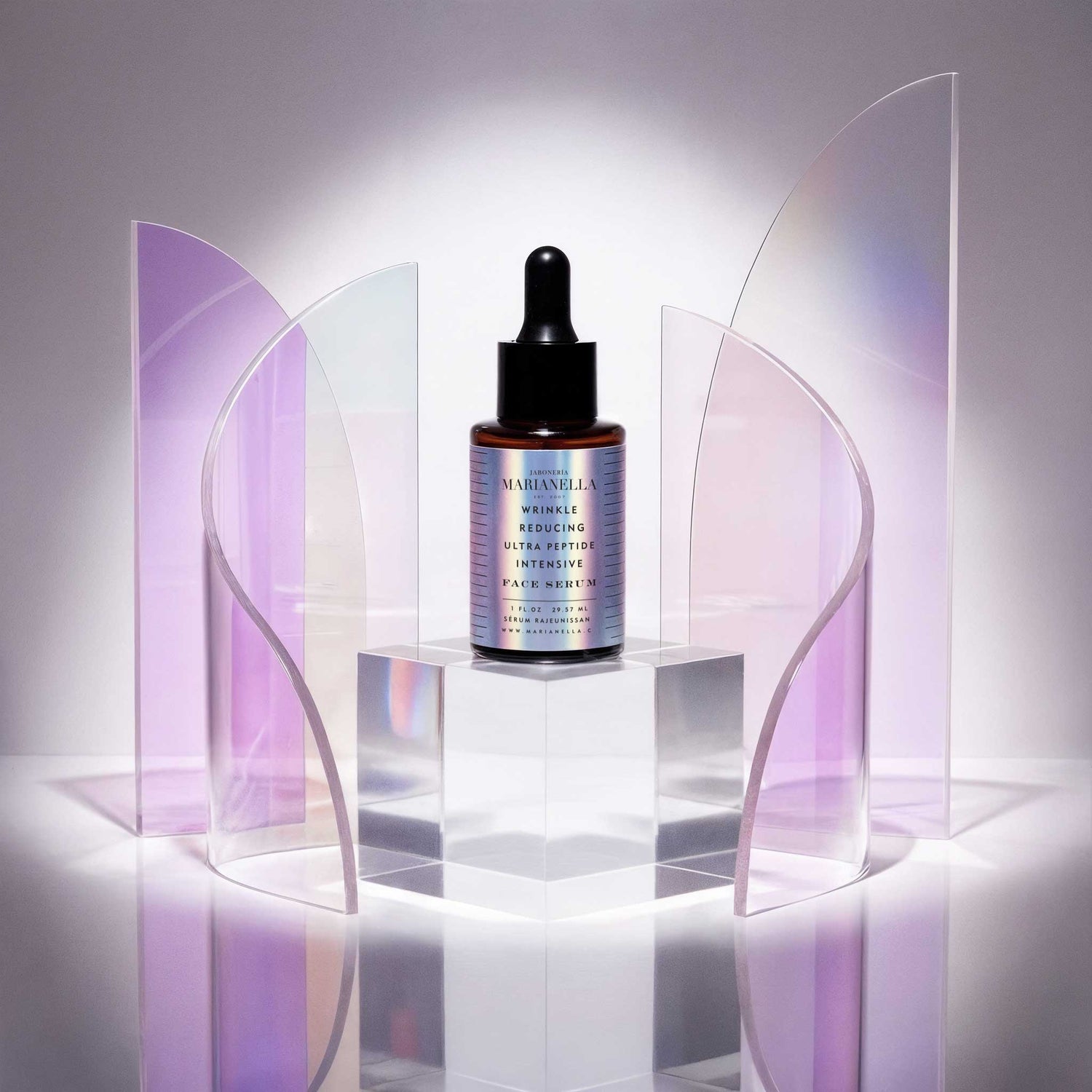
Wrinkle Reducing Ultra Peptide Intensive Face Serum
This serum is built for visible anti-aging results. Glycerin provides the hydration foundation that allows the peptide complex to work within a well-supported skin environment. Properly hydrated skin responds more effectively to active ingredients, and sustained moisture reduces the visual depth of expression lines. Featured in Vogue and recognized with the People Magazine Star Beauty Award, this formula represents Marianella's most intensive approach to the face.
Wrinkle Reducing Ultra Peptide Intensive Face Serum. $84.
Vitamin C Collagen Boosting Face Serum with Niacinamide
A brightening and firming serum where glycerin plays the hydration pairing role alongside Vitamin C and Niacinamide. Glycerin plays well with other skincare ingredients , and here it ensures the active ingredients are delivered into a receptive, hydrated skin surface. Dry skin creates a barrier to absorption. Glycerin removes it.
Vitamin C Collagen Boosting Face Serum with Niacinamide. $50.
Wrinkle Reducing Ultra Peptide Intensive Night Cream
Night is when skin repair is most active, and glycerin's sustained moisture-binding effect is particularly well-suited to overnight use. Seven full days after treatment stopped, glycerin-treated skin still showed significantly higher hydration and better barrier function than untreated areas , which underscores how well this ingredient performs when allowed to work undisturbed. This cream brings together Marianella's 18 years of formulation expertise in a product available now at Bloomingdale's BEAUTYSPACE.
Wrinkle Reducing Ultra Peptide Intensive Night Cream. $112.
How to Use Glycerin-Based Products Effectively
The science behind glycerin's effectiveness lies in its concentration-dependent behavior. Glycerin solutions with concentrations below 60% achieve optimal moisture retention while reducing water evaporation. In a finished serum or cream, formulation handles this. Your role is application technique.
Apply serums containing glycerin to slightly damp skin. This gives the humectant existing surface moisture to bind and hold, rather than drawing exclusively from deeper layers. In low-humidity environments, layer a cream or facial oil on top to seal the moisture in.
Sequence matters. Serums first, then creams. Thinner textures penetrate before denser ones form an occlusive layer. The Vitamin C Serum followed by the Ultra Peptide Night Cream is a precise pairing for this reason.
Why the Simplest Ingredients Are Often the Most Effective
Unlike many trendy ingredients, glycerin has decades of clinical evidence behind it, and it shows up in everything from drugstore lotions to high-end serums. In 2026, the beauty conversation is shifting back toward this kind of evidence. Consumers are reading labels, asking questions, and expecting brands to explain not just what an ingredient does, but how and why.
Glycerin is a well-studied and widely used humectant known for its ability to improve skin hydration, enhance cutaneous elasticity, and repair the epidermal barrier. Those three outcomes: hydration, elasticity, barrier repair, are the foundation of skin that ages well, holds up to environmental stress, and responds to active ingredients.
Marianella's 82 products across face, body, and home draw on Venezuelan heritage and three generations of botanical knowledge. Glycerin is not an afterthought in these formulas. It is structural. It is the science that makes everything else possible.
Explore the full face collection at marianella.co or find Marianella at Bloomingdale's BEAUTYSPACE.
```

Hinterlasse einen Kommentar
Diese Website ist durch hCaptcha geschützt und es gelten die allgemeinen Geschäftsbedingungen und Datenschutzbestimmungen von hCaptcha.